
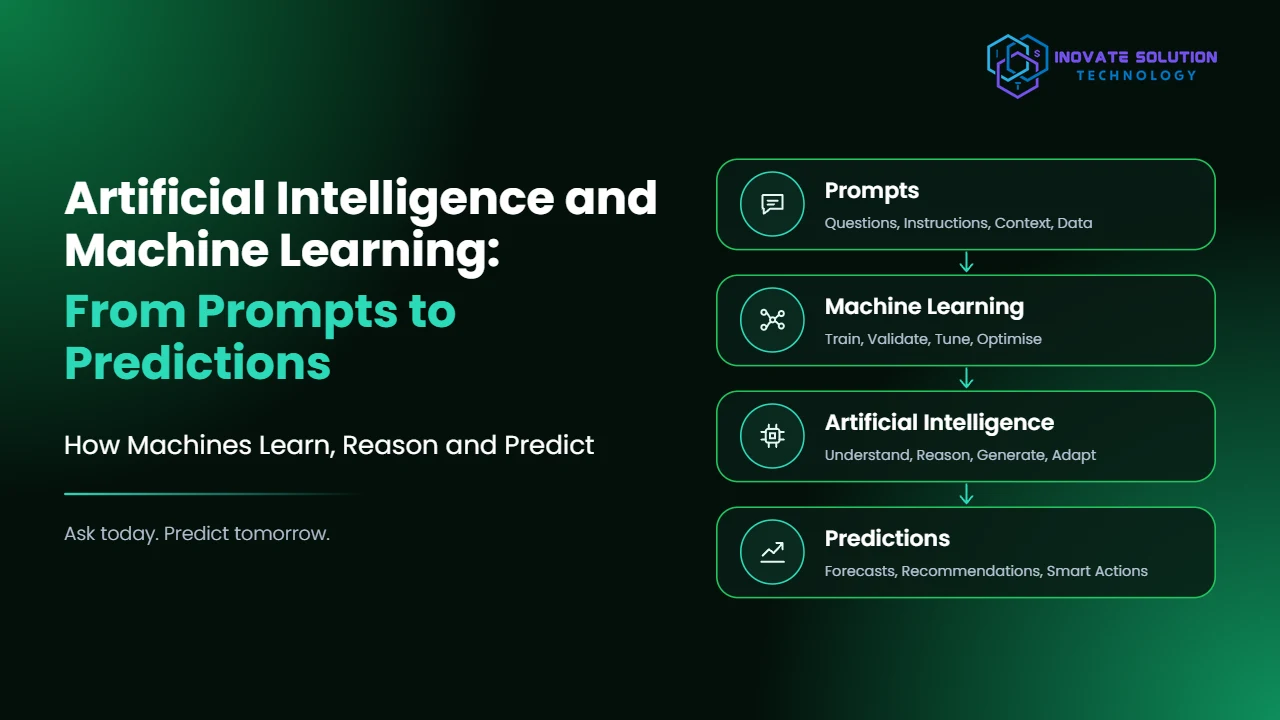
Introduction : The World Beyond Prompts
Have you ever wondered how AI tools answer your questions, generate images, or recommend videos within seconds? Behind these simple actions, intelligent technologies work with information, identify patterns, and generate useful results.Artificial Intelligence (AI) and Machine Learning (ML) are transforming the way people learn, work, and interact with technology. From virtual assistants to online shopping recommendations, these technologies have become part of our everyday lives.
Let's explore how AI and ML work, where they are used, and why they are important for the future.
TL;DR summary
Artificial Intelligence (AI) and Machine Learning (ML) are transforming everyday life by helping computers learn from data, identify patterns, and make predictions. From chatbots and virtual assistants to healthcare, finance, and education, AI is used across many industries. Understanding AI, learning Python, developing data skills, and practising through small projects can help beginners explore this growing technology. With responsible use and continuous learning, AI offers exciting opportunities for the future.
What Is Artificial Intelligence?
Artificial Intelligence is a field of computer science that focuses on creating systems capable of performing tasks that normally require human intelligence.These tasks include understanding language, recognising images, solving problems, and making recommendations.
For example:
• Voice assistants respond to spoken commands.
• Chatbots answer customer questions.
• Navigation apps suggest suitable routes.
• Streaming platforms recommend movies and music.
AI helps computers perform intelligent tasks and support people in solving real-world problems.
Understanding Machine Learning
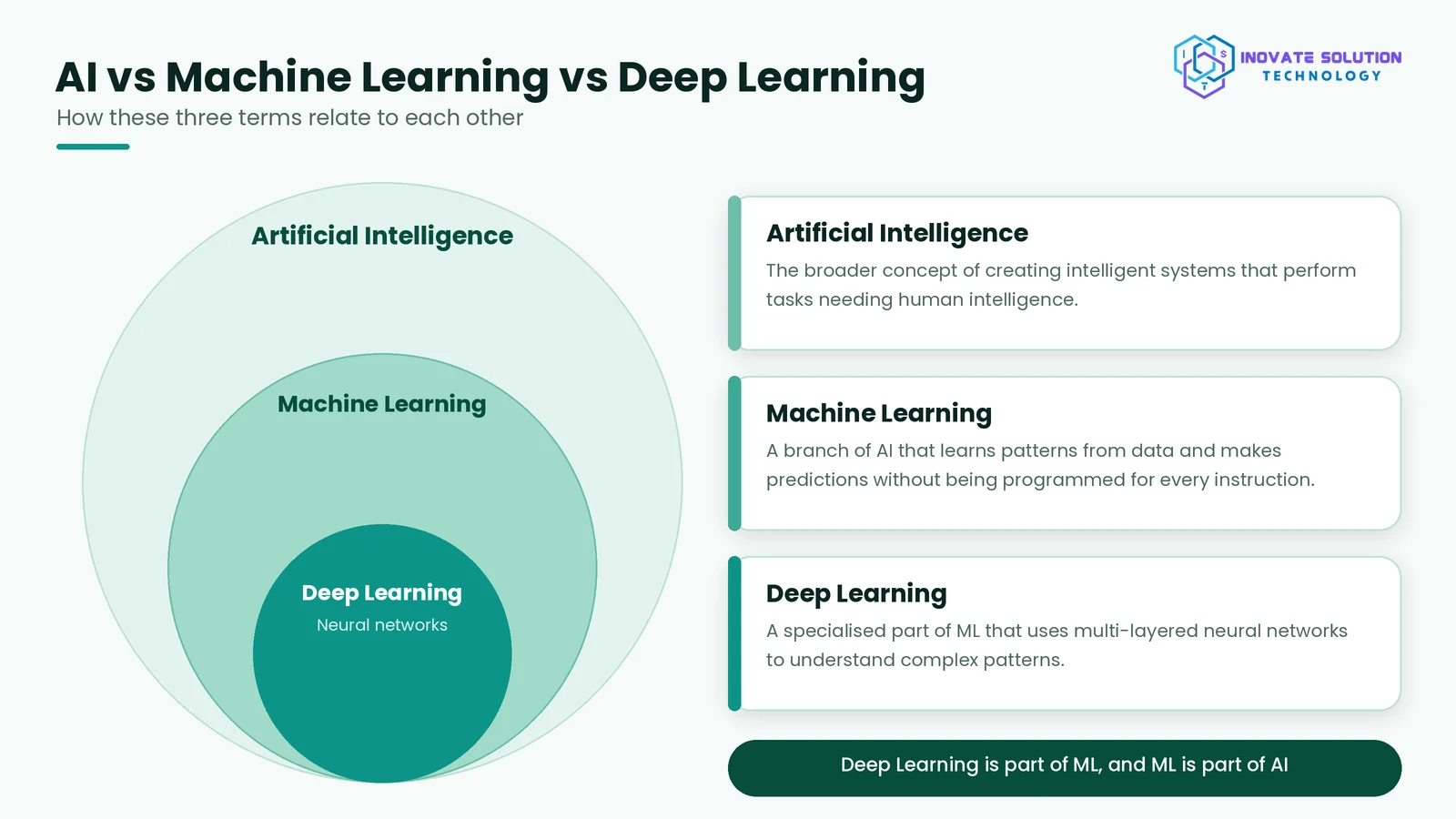
Machine Learning is a part of Artificial Intelligence that allows computers to learn patterns from data and make predictions without being programmed with every instruction.For example, email applications can identify spam messages by learning from examples of spam and genuine emails.
Machine Learning has three main approaches:
• Supervised Learning: Learns from labelled data. Example: Predicting house prices using previous housing information.
• Unsupervised Learning: Finds patterns in data without predefined labels. Example: Grouping customers based on shopping behaviour.
• Reinforcement Learning: Learns through rewards and feedback. Example: Training an AI system to play a game.
AI vs ML vs Deep Learning
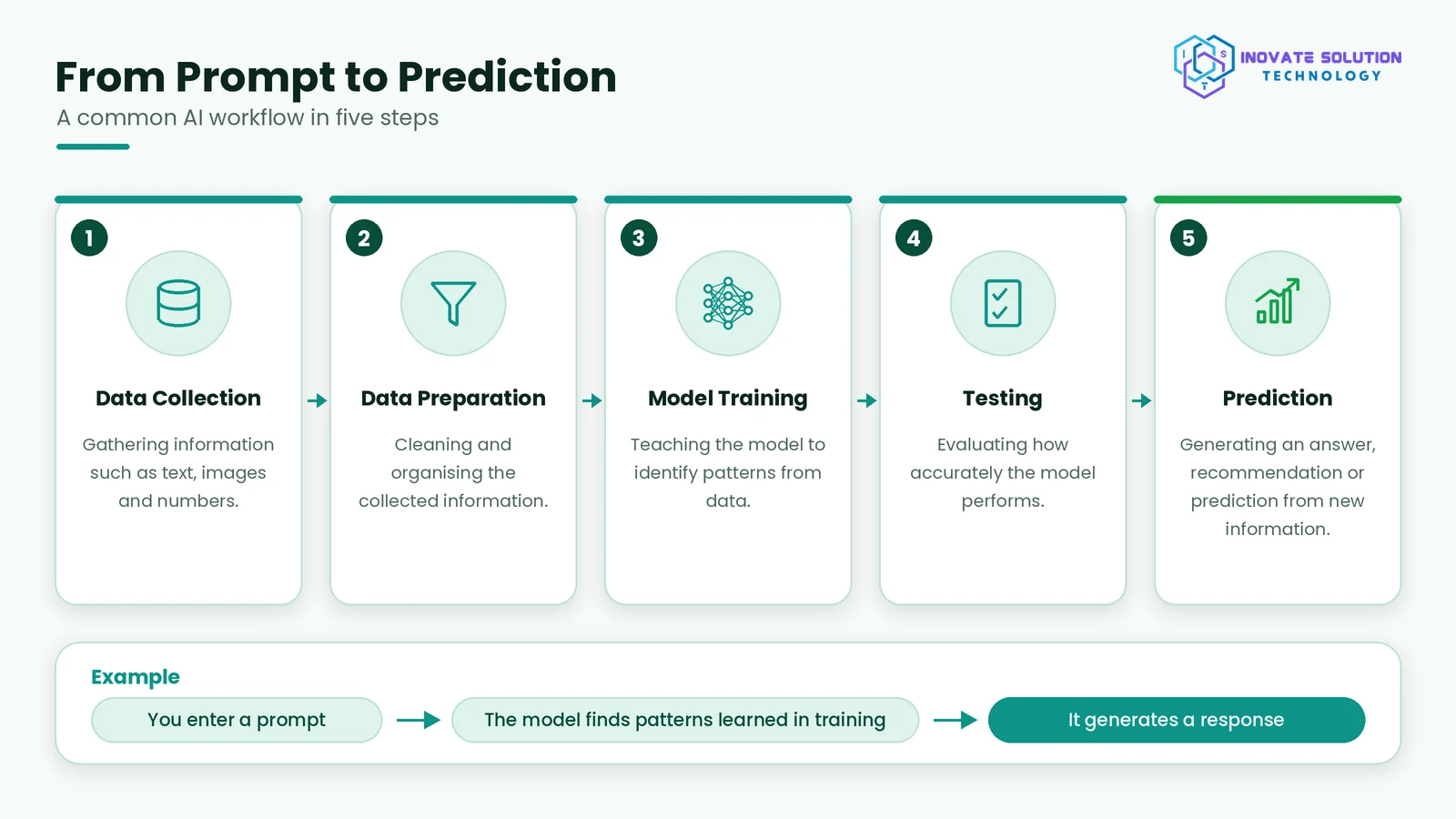
Although these terms are related, they have different meanings.
• Artificial Intelligence: The broader concept of creating intelligent systems.
• Machine Learning: A branch of AI that learns patterns from data.
• Deep Learning: A specialised part of ML that uses multi-layered neural networks to understand complex patterns.
In simple terms, Deep Learning is part of Machine Learning, and Machine Learning is part of Artificial Intelligence.
How Does AI Transform Prompts into Predictions?
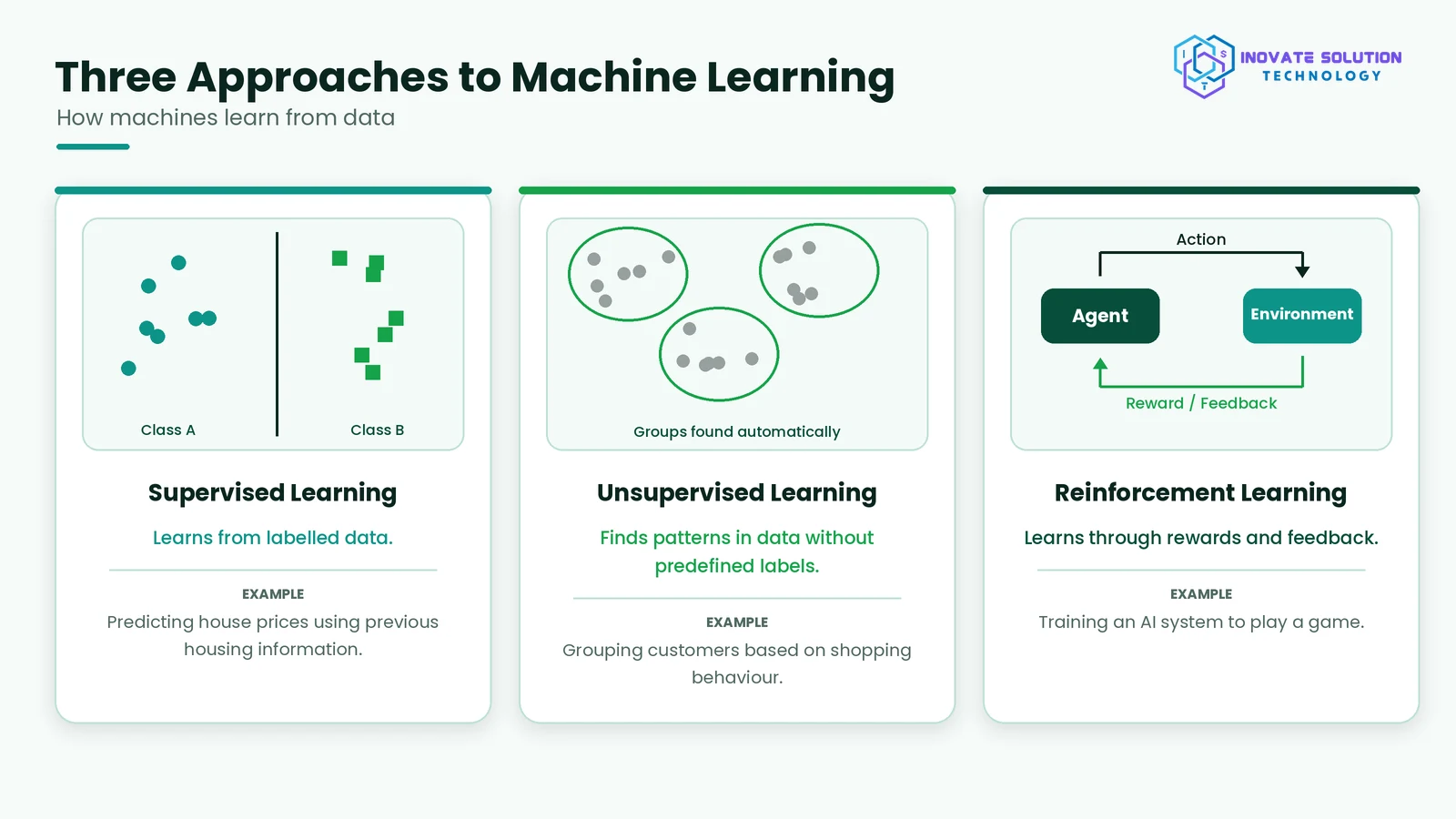
AI systems follow different processes depending on their purpose. A common workflow includes:
1. Data Collection: Gathering information such as text, images, and numbers.
2. Data Preparation: Cleaning and organising the collected information.
3. Model Training: Teaching the model to identify patterns from data.
4. Testing: Evaluating how accurately the model performs.
5. Prediction or Response: Generating an answer, recommendation, or prediction based on new information.
For example, when you enter a question into an AI chatbot, the language model processes your prompt and generates a response based on patterns learned during training and the conversation context.
AI in Everyday Life and Different Industries
AI is used in many areas of our daily lives and across different industries.
• Healthcare: Helps analyse medical images and supports medical professionals.
• Finance: Helps identify unusual transactions and detect potential fraud.
• Education: Supports personalised learning and recommends study materials.
• Agriculture: Helps monitor crop conditions and support farming decisions.
• Entertainment: Recommends movies, music, and videos based on user interests.
• Manufacturing: Supports quality inspection and equipment monitoring.
These applications show how AI can make processes more efficient and support better decisions.
Benefits and Challenges of AI
AI offers many benefits, including saving time, automating repetitive tasks, analysing large amounts of data, and supporting faster decisions.However, it also has challenges. AI systems may produce incorrect information, show bias, or create privacy concerns. Therefore, human supervision, accurate data, and responsible usage are important.
What Does the Future Hold?
Artificial Intelligence and Machine Learning are continuously developing. Technologies such as Generative AI, intelligent assistants, computer vision, and AI agents are creating new possibilities.The future is not just about making machines smarter. It is also about developing reliable and responsible technologies that work alongside people.
Quick Quiz: Test Your Knowledge
Let's see how much you've learned about AIML.
Q1. What is the main purpose of Artificial Intelligence?
A. Designing only computer hardware
B. Replacing all human activities
C. Creating systems that perform tasks requiring human intelligence
D. Storing information in computer databases
Q2. Which Machine Learning approach learns from labelled data?
A. Reinforcement Learning
B. Unsupervised Learning
C. Supervised Learning
D. Deep Learning
Q3. Deep Learning is a specialised part of Machine Learning that uses multi-layered neural networks.
A. True
B. False
Answers: Q1 — C | Q2 — C | Q3 — A
Conclusion: The Future Starts with Learning
Artificial Intelligence and Machine Learning are changing how we interact with technology. From simple recommendations to complex predictions, these technologies are becoming important in modern applications.Learning AI does not mean mastering everything at once. Start with the fundamentals, explore useful tools, and practise through small projects.
Behind every prompt is an opportunity to discover something new. Start learning today and become part of the future of technology!
Frequently asked questions
Is AI the same as Machine Learning?
No. AI is the broader field, while Machine Learning is a part of AI that learns patterns from data.
Is Python necessary for learning AI?
Python is widely used in AI development, and learning it is helpful for beginners.
Can beginners learn AI?
Yes. Beginners can start with programming, basic mathematics, and introductory machine learning concepts.
Does AI always provide accurate answers?
No. AI can generate incorrect or biased information, so its results should be checked.
Where is Machine Learning used?
It is used in healthcare, finance, shopping recommendations, fraud detection, image recognition, and many other fields.

Arun G
Full stack developerA passionate technology enthusiast with an interest in web development, innovation, and emerging technologies. Enjoys creating user-friendly digital experiences, exploring new tools, and turning creative ideas into practical solutions.
Join the conversation
Be the first to share your thoughts.