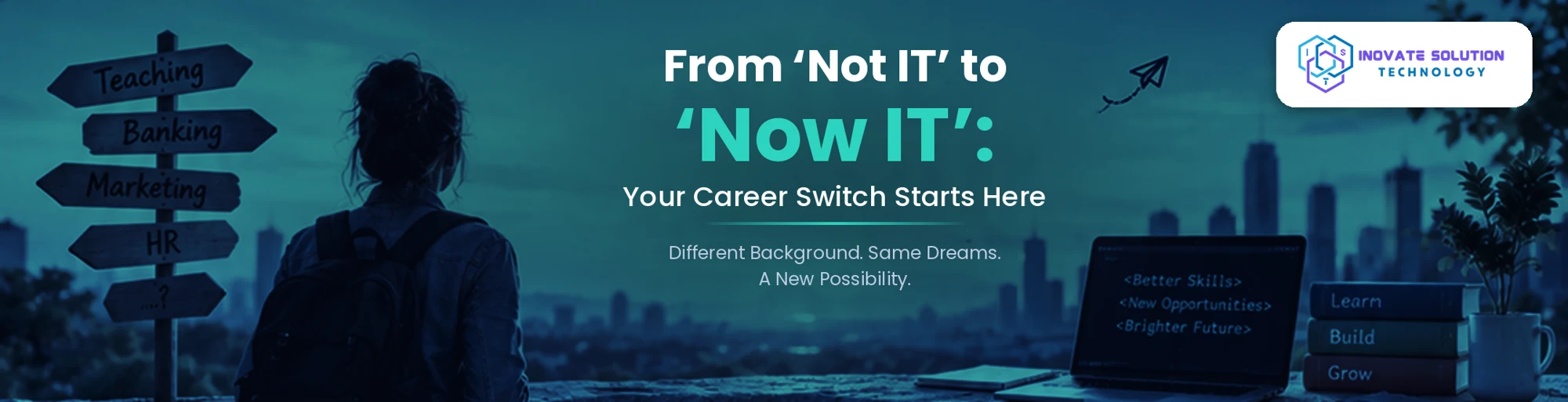
Introduction : Is Your Current Career Your Final Destination?
Many of us choose a career based on what is available, what others expect, or what seems right at the time. But somewhere along the way, we may start wondering: “Is this really where I want to be?”
If you work in a non-IT field and feel curious about technology, better opportunities, or a more meaningful challenge, you are not alone. The good news is that a career change is possible. You do not have to start your life over — you need a clear plan, relevant skills, and the willingness to keep learning.
TL;DR summary
Switching from a non-IT background to the technology industry is possible with the right planning, skills, and consistent effort. Start by choosing a suitable IT career path, learning the required skills, and gaining practical experience through projects. Build a strong portfolio, highlight your transferable skills in your resume, and prepare for interviews. With a clear 90-day roadmap and continuous learning, you can take confident steps towards a new career in IT.
Can You Really Switch from Non-IT to IT?
Yes. People move into technology from many educational and professional backgrounds. A Computer Science degree is not mandatory for every IT role, although some employers and positions have specific degree or eligibility requirements.
The important part is to understand what your target role requires and build evidence that you can do the work. Learning takes time, and completing a course alone does not guarantee a job. Practical skills, projects, communication, and interview preparation can all strengthen your chances.
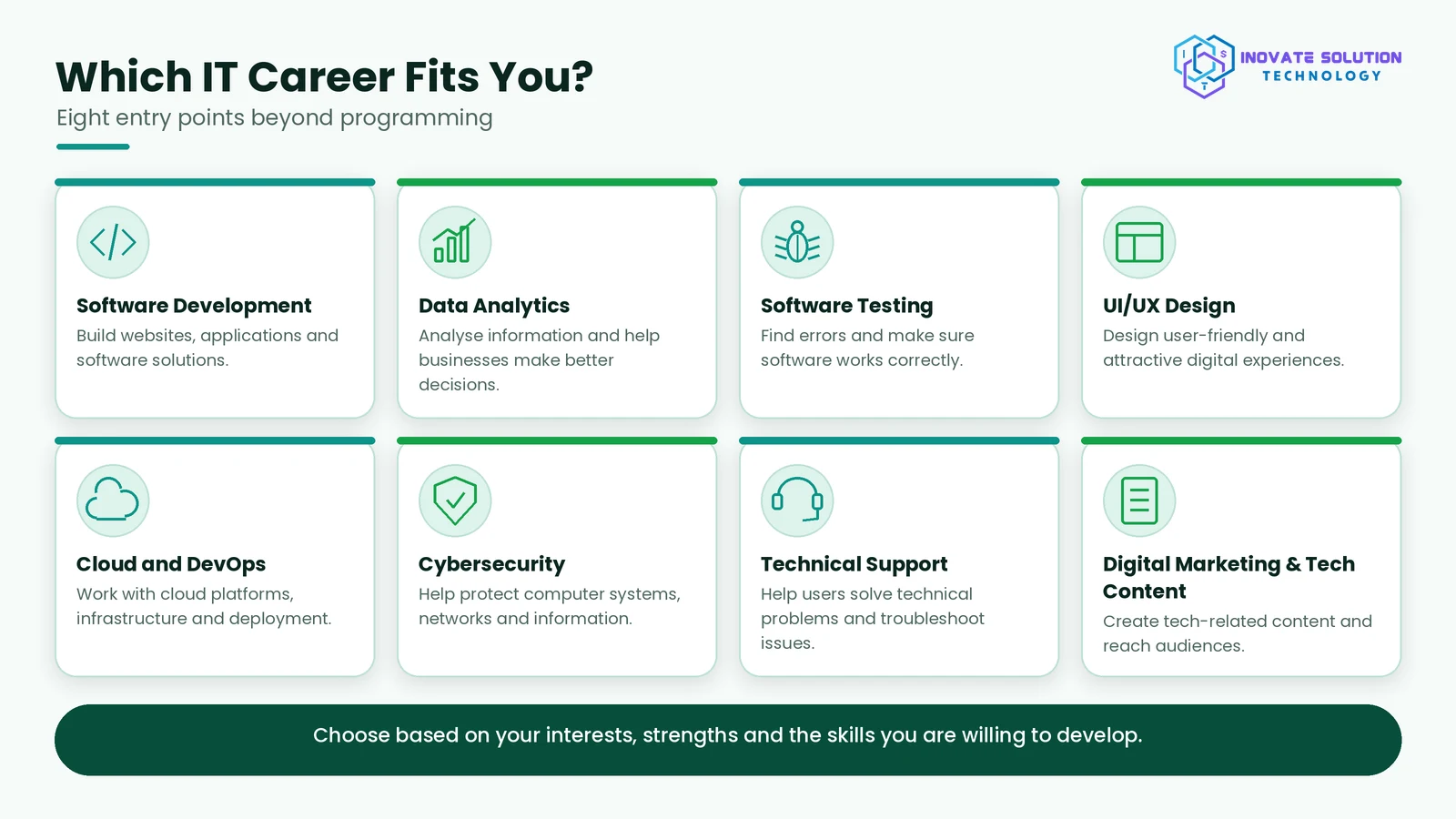
Find Your Entry Point: Which IT Career Fits You?
The IT industry offers many career options beyond programming. Before choosing a course, understand the different roles and identify what interests you.
Some popular career options include:
• Software Development: Build websites, applications, and software solutions using programming languages.
• Data Analytics: Analyse information, identify patterns, and help businesses make better decisions.
• Software Testing: Test applications, identify errors, and ensure that software works correctly.
• UI/UX Design: Design user-friendly and attractive digital experiences.
• Cloud and DevOps: Work with cloud platforms, infrastructure, and software deployment.
• Cybersecurity: Help protect computer systems, networks, and information.
• Technical Support: Help users solve technical problems and troubleshoot issues.
• Digital Marketing and Tech Content: Use digital platforms and technology-related knowledge to create content and reach audiences.
Choose a career based on your interests, strengths, and the skills you are willing to develop.
Your Previous Experience Is Still Valuable
One common concern among career switchers is that their non-IT experience may not be useful in technology. However, many skills can be transferred between industries.
For example:
• Teachers have communication, presentation, and training skills.
• Accountants have analytical thinking and attention to detail.
• Customer service professionals have problem-solving and people-management skills.
• Project coordinators have planning, organisation, and teamwork abilities.
These strengths can support your transition into an IT role. The important thing is to explain how your previous experience connects with your new career goals.
Learn the Right Skills and Practise Regularly
When entering IT, it is easy to become confused by the number of programming languages, tools, and technologies available.Instead of trying to learn everything, focus on the skills required for your chosen career.
Follow these simple steps:
1. Research entry-level job descriptions to understand the required skills.
2. Choose a suitable online course or structured learning resource.
3. Practise what you learn through small exercises.
4. Take notes and try explaining technical concepts in your own words.
5. Stay consistent and avoid frequently changing your learning path.
Remember, practical experience is just as important as theoretical knowledge.
Build Projects and Create Your Portfolio
Learning becomes more effective when you apply your knowledge to real projects. A portfolio helps employers understand your practical abilities.You can start with small projects related to your chosen field. For example, aspiring developers can create websites, data analytics learners can build dashboards, and UI/UX designers can prepare design prototypes.
When creating your portfolio:
• Include projects that you understand clearly.
• Mention the tools and technologies you used.
• Explain the purpose of each project.
• Highlight your individual contribution.
• Keep your work updated as you learn new skills.
Even a few well-explained projects can demonstrate your interest and practical knowledge.
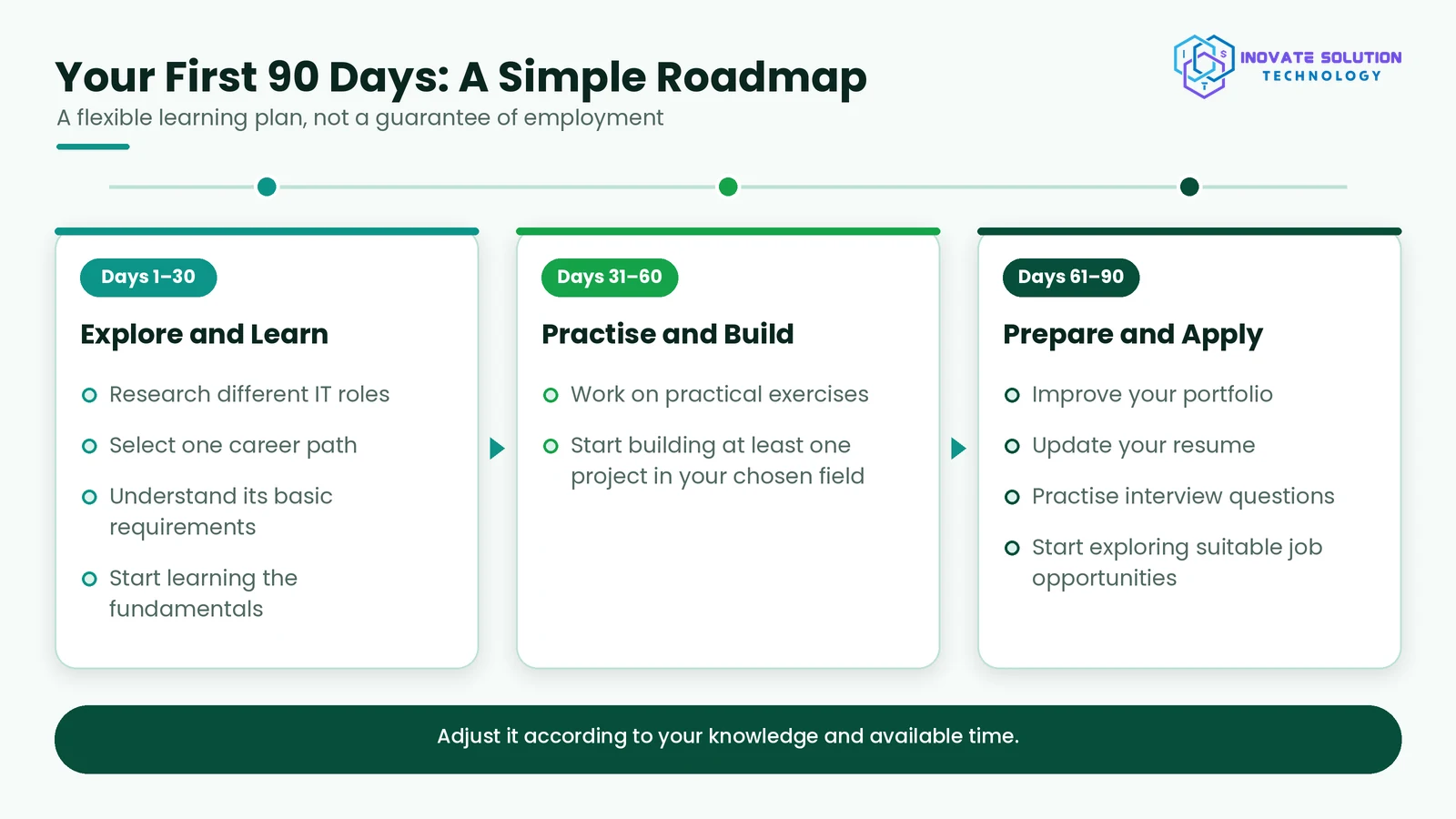
Your First 90 Days: A Simple Roadmap
Days 1–30: Explore and Learn
Research different IT roles, select one career path, and understand its basic requirements. Start learning the fundamentals.
Days 31–60: Practise and Build
Work on practical exercises and start building at least one project related to your chosen field.
Days 61–90: Prepare and Apply
Improve your portfolio, update your resume, practise interview questions, and start exploring suitable job opportunities.
This is a flexible learning roadmap, not a guarantee of employment. Adjust it according to your knowledge and available time.
Common Challenges and Mistakes to Avoid
Changing careers may involve challenges such as limited study time, lack of practical experience, difficulty understanding technical concepts, and job rejections.
You can manage these challenges by following a realistic learning schedule, practising consistently, and improving your skills step by step.
Also, avoid these common mistakes:
• Trying to learn too many technologies at once.
• Collecting certificates without practical experience.
• Copying projects without understanding the code.
• Using the same resume for every job application.
• Expecting a guaranteed job within a few weeks.
Focus on learning and improving rather than rushing the process.
Quick Quiz: Test Your Knowledge
Q1. What is the first important step when planning a career switch from non-IT to IT?
A. Learn every programming language
B. Choose a suitable IT career path
C. Collect as many certificates as possible
D. Apply for jobs immediately
Q2. Which IT career mainly involves analysing information and identifying patterns?
A. Data Analytics
B. Technical Support
C. Software Testing
D. UI/UX Design
Q3. Previous non-IT work experience can provide transferable skills that are useful in technology careers.
A.True
B.False
Q4. Completing an online course alone guarantees a job in the IT industry.
A.True
B.False
Answers: Q1 — B | Q2 — A | Q3 — A | Q4 — B
Conclusion: Your Next Chapter Starts with One Step
Moving from a non-IT background to the technology industry may seem challenging, but it is achievable with proper planning and consistent effort.Your previous experience is not a limitation. The skills you have already developed can become valuable strengths in your new career. Start by choosing one IT role, learning the required skills, and building practical projects.You do not have to know everything today. Take the first step, keep learning, and give yourself the opportunity to grow.
Your background is where your story began, not where it has to end!
Frequently asked questions
Can I enter IT without a Computer Science degree?
Yes. Some IT roles and employers accept candidates from different educational backgrounds. Requirements depend on the position and organisation.
Do I need coding skills to enter IT?
Not for every role. Software development requires programming, but fields such as UI/UX design, technical support, and some digital roles have different requirements.
How long does it take to switch from non-IT to IT?
There is no fixed timeline. It depends on your current knowledge, chosen career path, learning time, and practical experience.
Are online courses enough to get an IT job?
Online courses help you learn, but practical projects, relevant skills, communication, and interview preparation are also important
Can I learn IT while working in another field?
Yes. If possible, you can learn alongside your current job by following a realistic study schedule.

Keerthika R
Full stack developerInterested in exploring new skills, simplifying complex ideas, and creating useful learning content.Focuses on making knowledge accessible, practical, and engaging for readers.
Join the conversation
Be the first to share your thoughts.