
Introduction
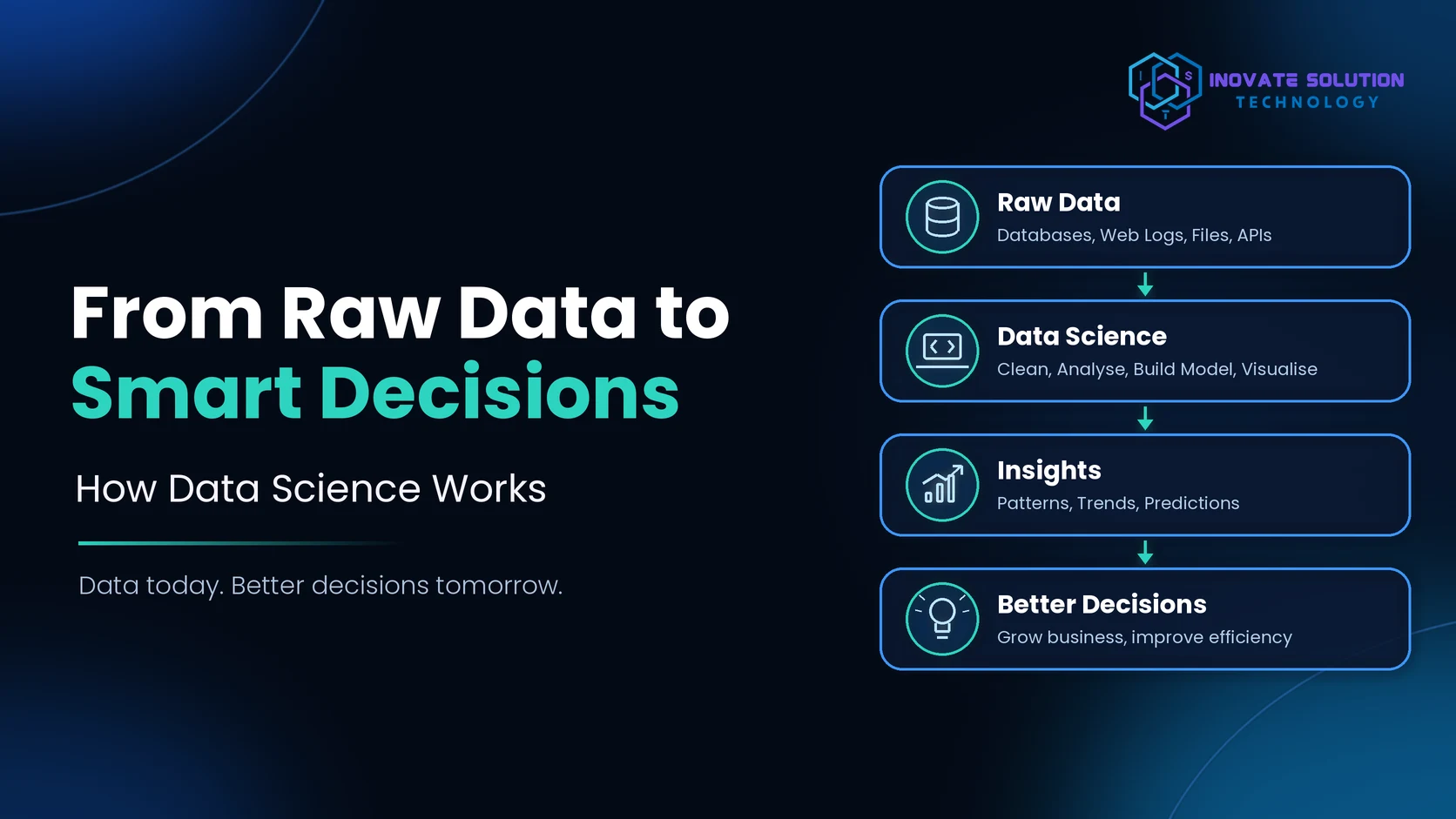
Every day, businesses generate enormous amounts of data through customer purchases, website visits, mobile applications, online transactions, and many other activities. But have you ever wondered how companies turn all this information into useful decisions? Imagine an online shopping company noticing that certain products sell more during particular months. By analysing previous sales, customer preferences, and seasonal trends, the company can estimate future demand and prepare its inventory accordingly. This is where Data Science comes in. Data science helps organisations transform raw data into meaningful insights that support better decisions. From recommending products to predicting sales trends, it plays an important role in modern technology and business.But how does this process actually work? Let's explore how data moves from its raw form to valuable insights.
TL;DR summary
Data science combines data, statistics, programming, and analytical techniques to discover useful patterns and support decision-making. The process typically involves collecting data, cleaning it, exploring patterns, building models when needed, evaluating results, and communicating insights. Businesses use these insights to understand customers, predict trends, improve operations, and make informed decisions.
What Is Data Science?
Data science is a field that uses scientific methods, statistics, programming, and analytical techniques to extract useful information from data.Raw data, by itself, may not tell us much. It could contain thousands of sales records, customer reviews, website visits, or transaction details. Data science helps organise and analyse this information to identify patterns and answer important questions.
For example, a company might ask: • Which products are most popular among customers? • During which months do sales increase? • Why are customers leaving a service? • How much stock might be needed next month?
By analysing relevant data, a company can make better-informed decisions instead of relying entirely on assumptions.In simple terms, data science turns information into insights that people can use.
How Does Data Science Work?
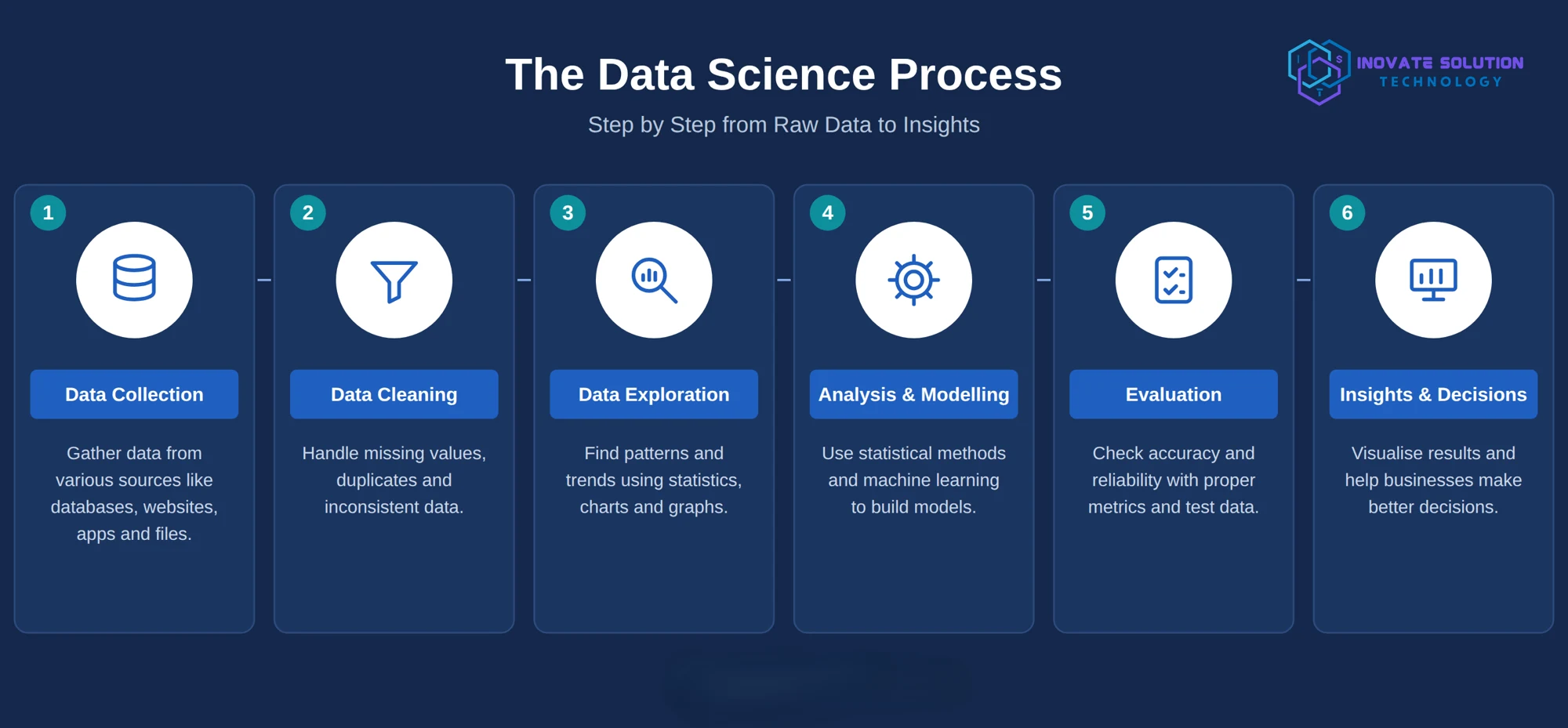
Data science is not a single action. It is a process involving several stages, from gathering information to communicating the results.
Step 1: Data Collection - The first step is collecting relevant data from suitable sources. Data may come from databases, websites, mobile applications, customer surveys, sensors, or business records.For example, an online store might collect information about product sales, prices, order dates, and quantities purchased.The goal is to gather information that can help answer a specific business question.
Step 2: Data Cleaning - Raw data is not always ready for analysis. It may contain missing values, duplicate records, incorrect entries, or inconsistent formats.Data cleaning involves identifying and addressing these problems.For example, if a sales database contains the same order twice, the duplicate could lead to an incorrect calculation of total sales.Cleaning the data helps make the analysis more reliable. However, missing or unusual values should be handled carefully because removing useful information can also affect the results.
Step 3: Data Exploration - Once the data has been prepared, the next step is to explore it and understand what it contains.Data scientists use statistics, tables, charts, and graphs to identify patterns, relationships, and unusual observations.For example, a sales chart might reveal that umbrella sales increase during rainy months.This stage helps analysts discover trends and decide which questions deserve further investigation.
Step 4: Data Analysis and Model Building - After exploring the data, data scientists may apply statistical methods or machine learning algorithms to answer more complex questions.A machine learning model is a system that learns patterns from data and uses them to make predictions or classifications.For example, an online retailer could use historical sales data to estimate how many units of a product might be needed next month.Not every data science project requires machine learning. Sometimes, a simple calculation, statistical analysis, or visualisation is enough to answer the business question.
Step 5: Evaluation and Validation - Before using the results, it is important to check whether they are reliable and useful.For a predictive model, data scientists evaluate its performance using appropriate metrics and test data that was not used to train the model.For example, if a model predicts product demand, its predictions can be compared with actual sales to understand how well it performs.If the results are inaccurate or unreliable, the team may need to improve the data, adjust the approach, or use a different model.
Step 6: Visualisation and Decision-Making - The final step is communicating the findings in a way that people can understand and act upon.Dashboards, charts, reports, and summaries help business teams interpret the results.For example, a dashboard might show which products are selling quickly and which products have excess stock.Managers can use these insights to plan inventory, adjust purchasing decisions, and prepare for changes in demand.The goal is not simply to analyse data. It is to use the findings to support better decisions.
A Real-World Example: Predicting Product Demand
Let's understand the process through a simple example.
Imagine an online shopping company that sells mobile phones, headphones, and smartwatches. The company wants to know how much stock it should prepare for the next month.Here is how data science can help. 1. Collect: Gather historical sales records, product prices, order dates, and available inventory information. 2. Clean: Remove duplicate orders, correct inconsistent entries, and address missing values appropriately. 3. Analyse: Identify products with increasing demand and examine seasonal sales patterns. 4. Predict: If sufficient relevant data is available, build and evaluate a model to estimate future product demand. 5. Decide: Use the results alongside supplier timelines, current stock, and business requirements to plan purchases.
For example, if the analysis suggests that headphone demand may increase during a seasonal sale, the company can prepare additional stock in advance.The prediction is not guaranteed to be correct. Unexpected events, price changes, and customer behaviour can affect actual demand. However, a well-evaluated forecast can help the company plan more effectively.This example demonstrates how data science can connect historical information with practical business decisions.
Tools Used in Data Science
Data scientists use different tools depending on the project, the size of the dataset, and the problem they need to solve.
• Python - Python is a popular programming language for data analysis, automation, visualisation, and machine learning. • SQL - SQL is used to retrieve, filter, and manage data stored in relational databases. It is particularly useful when working with large collections of business records. • Pandas - Pandas is a Python library that helps organise, clean, transform, and analyse structured data. • Matplotlib - Matplotlib is a Python library used to create charts and graphs that help reveal patterns in data. • Scikit-learn - Scikit-learn provides tools for building and evaluating many machine learning models, including classification, regression, and clustering algorithms.
These tools work together in many data science workflows. For example, a data scientist might use SQL to retrieve sales records, Pandas to clean the data, Matplotlib to visualise trends, and Scikit-learn to build a predictive model.
Real-World Applications of Data Science
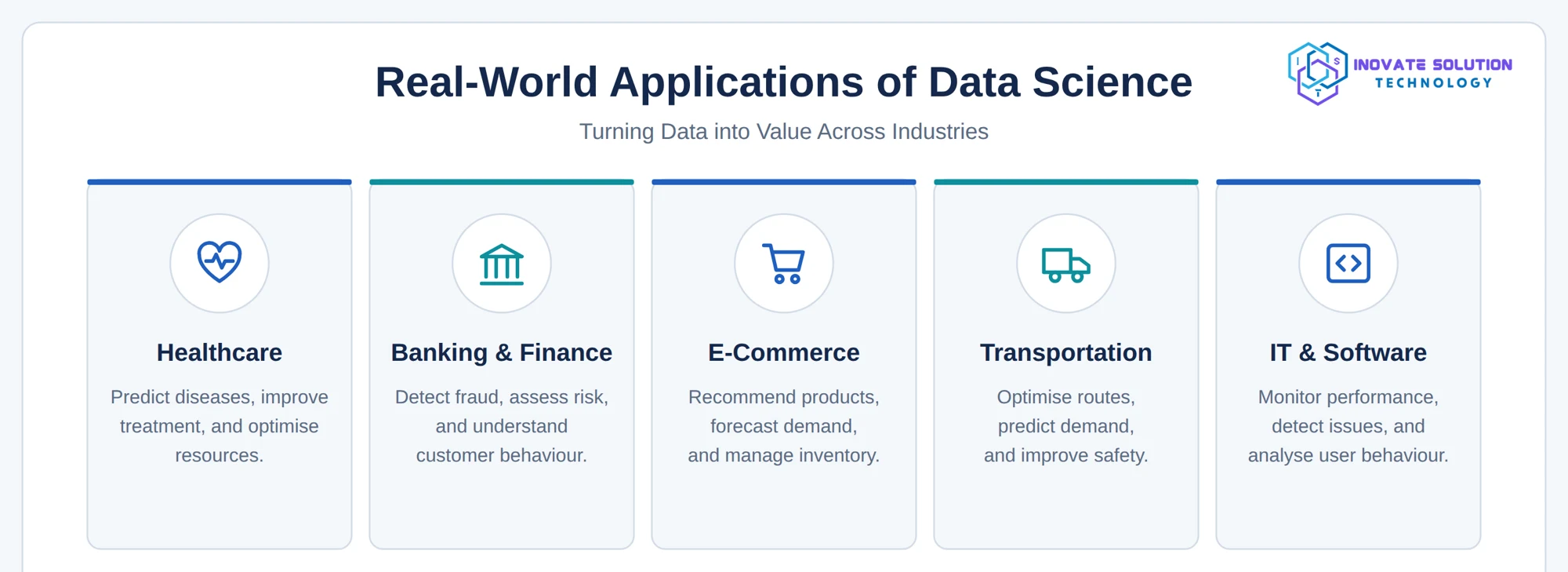
Data science is used across many industries to solve different types of problems.
Healthcare : Healthcare organisations can analyse relevant patient and operational data to identify patterns, support resource planning, and assist research. Applications involving patient care require careful attention to privacy, data quality, and clinical validation.
Banking and Finance : Financial institutions use data analysis and predictive models to identify potentially fraudulent transactions, assess certain financial risks, and understand customer activity.
E-Commerce : Online shopping platforms analyse customer activity and purchase histories to recommend products, forecast demand, and improve inventory planning.
Transportation : Transportation companies use data to study traffic patterns, estimate journey times, and plan routes more efficiently.
IT and Software Development : IT companies use data analysis to monitor application performance, identify usage patterns, detect unusual activity, and understand how users interact with software.
Across these industries, data science helps organisations find patterns and make more informed decisions.
Challenges in Data Science
Although data science offers many benefits, the process also comes with challenges.
Poor data quality: Incomplete, outdated, or incorrect data can lead to misleading conclusions. Data privacy: Personal information must be handled responsibly and protected from unauthorised access. Bias in data: If the available data does not represent the real situation fairly, the results may disadvantage certain groups or produce inaccurate conclusions. Incorrect interpretation: A pattern in the data does not always prove that one factor caused another. Changing conditions: A model that performs well today may become less accurate when customer behaviour or market conditions change.
To address these challenges, data science teams need reliable data practices, appropriate evaluation methods, privacy safeguards, and regular monitoring.
Quick Quiz: Test Your Knowledge
Let's see how much you've learned about Data Science.
Q1. What is the main purpose of Data Science? A. To store large amounts of data B. To transform raw data into meaningful insights C. To design websites D. To develop mobile applications
Q2. Which Python library is commonly used for data cleaning and analysis? A. Matplotlib B. Scikit-learn C. Pandas D. SQL
Q3. Why is data cleaning important in Data Science? A. To remove or address data errors and duplicates B. To increase the size of the dataset C. To create website layouts D. To replace all data with predictions
Answers: Q1 — B | Q2 — C | Q3 — A
Conclusion
Data science is more than collecting numbers or creating charts. It is a systematic process of transforming raw information into insights that help people solve problems and make informed decisions.From collecting and cleaning data to analysing patterns, evaluating predictions, and communicating results, each stage contributes to the quality of the final outcome.For businesses, the value of data science lies in how effectively insights can be applied to real-world challenges. For aspiring professionals, learning programming, statistics, data analysis, and critical thinking can provide a strong starting point.As organisations continue to generate and use data, the ability to understand information and turn it into meaningful action remains an important skill in the technology industry.Raw data provides the information. Data science helps reveal the meaning. Smart decisions turn that meaning into action.
Frequently asked questions
Is data science only about programming?
No. Data science also involves statistics, data preparation, critical thinking, communication, and understanding the problem being solved. Programming is one important part of the process.
Which programming language is commonly used in data science?
Python is widely used because it supports data analysis, visualisation, automation, and machine learning. SQL is also important for working with databases.
Is machine learning required for every data science project?
No. Some problems can be solved through basic statistical analysis, data visualisation, or simple calculations. Machine learning is useful when the problem requires methods such as prediction or classification.
Can beginners learn data science?
Yes. Beginners can start with basic Python, statistics, spreadsheets, and SQL before progressing to data analysis and machine learning.
How does data science help businesses?
It can help businesses understand customer behaviour, forecast demand, identify unusual patterns, improve operations, and make better-informed decisions.

Shalini B
Founder & CEOShalini B, Founder & CEO of Inovate Solution Technology, is a technology professional specializing in Cloud Computing, DevOps, and Software Development.Passionate about innovation and digital transformation, she shares industry insights to empower students, developers, and businesses.
Join the conversation
Be the first to share your thoughts.