
Introduction
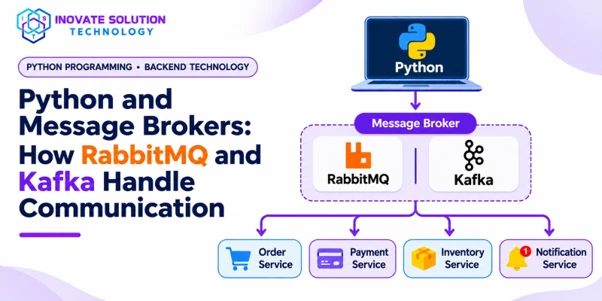
Imagine placing an order on an online shopping application. Within seconds, you receive an order confirmation. Your payment gets processed, the product inventory is updated, and a notification arrives on your phone.Have you ever wondered how all these things happen so quickly?
Behind the scenes, different parts of the application communicate with each other to complete these tasks. When an application grows and handles thousands of requests, managing all this communication can become challenging.This is where Message Brokers become useful.RabbitMQ and Apache Kafka are two popular technologies that help different applications exchange information smoothly. Python can connect with these technologies and help developers build applications that handle tasks more efficiently.
Let's understand how they work and why they are important in modern backend development.
TL;DR summary
When multiple services need to communicate, managing everything directly can become complicated. Message brokers make this easier by acting as a middle layer between applications.RabbitMQ mainly handles messages through queues, while Apache Kafka is designed to manage continuous streams of events. Python applications can connect to both and use them to build reliable backend systems.
Why Do Applications Need Message Brokers?
Let's take a simple example of an online shopping application.
When you place an order, several things need to happen:
1. Your order details must be saved.
2. The payment needs to be processed.
3. The product inventory must be updated.
4. You should receive an order confirmation.
All these tasks are handled by different parts of the application.Now imagine every service trying to communicate directly with every other service. As the application grows, these connections become harder to manage.A message broker makes this process simpler.Instead of services communicating directly, they send messages through a common system called a message broker. It receives the messages and makes them available to the appropriate services.Think of it like a post office. You give your parcel to the post office, and it takes care of getting it to the correct destination.
That's the basic idea behind a message broker.
What Is RabbitMQ and How Does It Work?
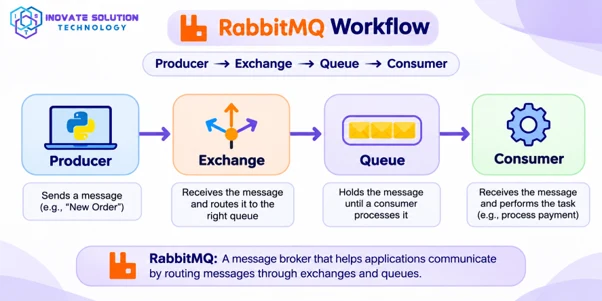
RabbitMQ is a message broker that helps applications send, receive, and manage messages.It uses queues to hold messages until another application is ready to process them.
To understand RabbitMQ, let's look at four important components:
● Producer: The application that sends a message.
● Exchange: Receives messages and decides where they should go.
● Queue: Holds messages until they are processed.
● Consumer: Receives and processes the messages.
Imagine you have just placed an order.
1. Your Python application sends the order details to RabbitMQ.
2. RabbitMQ receives the message through an exchange.
3. The exchange routes it to the appropriate queue.
4. The payment service receives the message and processes the payment.
5. After successful processing, the service acknowledges the message.
This way, the application does not need to wait for every service to complete its work before continuing.RabbitMQ also supports message acknowledgements, which help ensure that messages are handled properly.
What Is Apache Kafka and How Does It Work?
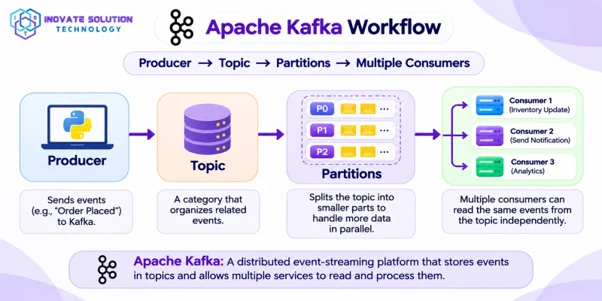
Apache Kafka is another popular technology, but it works differently from RabbitMQ.It is designed to handle continuous streams of data, especially when applications need to process large amounts of information.Kafka organizes information into topics, where related events are stored.
Here are some important components:
● Producer: Sends events to Kafka.
● Topic: Stores related events.
● Consumer: Reads and processes events.
● Partition: Divides a topic into smaller parts to support scalability.
● Offset: Keeps track of a consumer's reading position.
Imagine a customer places an order. The application publishes an event called Order Placed to a Kafka topic.Different services can read this same event:
1. The inventory service updates product availability.
2. The notification service sends an order confirmation.
3. The analytics service records the order information.
One interesting feature of Kafka is that it retains events according to its configured retention settings.This means consumers can read previously published events again when needed, rather than relying only on a message being delivered once.This makes Kafka useful for applications that work with continuous data and event processing.
How Does Python Communicate with RabbitMQ and Kafka?
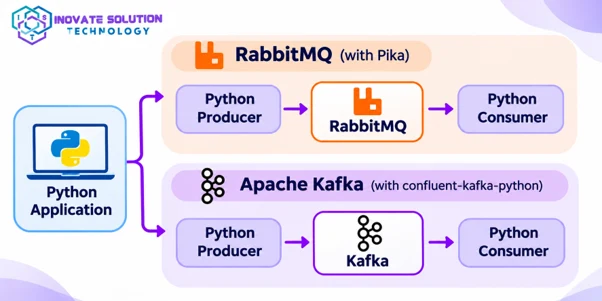
Now, where does Python fit into all this?
Python applications can connect to both RabbitMQ and Kafka using dedicated libraries.
● RabbitMQ: Developers commonly use the Pika library.
● Kafka: Developers can use the confluent-kafka-python library.
The basic communication process is simple:
1. A Python application creates a message.
2. It sends the message to RabbitMQ or Kafka.
3. The broker receives and routes or stores the message.
4. Another application reads the message.
5. The receiving application performs the required task.
For example, one Python application can send an order confirmation request, while another application receives it and sends an email to the customer.
This allows different services to work independently while still sharing information.
Where Are Message Brokers Used?
Message brokers are not limited to online shopping applications. They are useful in many areas of technology.
● E-commerce: Handling orders, payments, and inventory updates.
● Banking: Sharing transaction events between services.
● Healthcare: Exchanging information between connected systems.
● Real-Time Analytics: Processing continuous streams of application data.
● Notifications: Sending emails, messages, and alerts through background tasks.
As applications grow, message brokers help developers manage communication without making every service depend directly on another.
Quick Quiz: Test Your Knowledge
Q1. What is the main purpose of a message broker?
A. Designing websites
B. Helping applications exchange messages
C. Creating images
D. Writing HTML code
Q2. Which RabbitMQ component holds messages until they are processed?
A. Queue
B. Partition
C. Offset
D. Topic
Q3. What is the main purpose of a Kafka topic?
A. Storing related events
B. Designing user interfaces
C. Managing Python packages
D. Creating databases
Q4. Which Python library is commonly used to communicate with RabbitMQ?
A. NumPy
B. Pandas
C. Pika
D. Matplotlib
Answers: Q1 — B | Q2 — A | Q3 — A | Q4 — C
Conclusion
Modern applications involve more than just writing code and displaying information. Behind every successful application, different services work together to complete tasks.Message brokers make this communication easier.RabbitMQ helps manage messages through queues and routing, while Kafka focuses on event streaming and handling continuous data. Python connects with both through dedicated libraries, allowing developers to build flexible backend applications.Understanding these technologies is an important step towards learning how modern backend systems work.
The next time you receive an order confirmation or a payment notification within seconds, remember that different services may be communicating behind the scenes to make it happen.
Frequently asked questions
What is a message broker in simple terms?
A message broker is a tool that helps different applications exchange information without communicating directly with each other.
Are RabbitMQ and Kafka programming languages?
No. They are messaging technologies. Python is a programming language that can connect to both.
Can Python work with both RabbitMQ and Kafka?
Yes. Python supports RabbitMQ through libraries such as Pika and Kafka through confluent-kafka-python.
What is the difference between a queue and a topic?
A queue holds messages for consumers to process. A Kafka topic organizes events that consumers can read independently.

Jaiharini K S
Full stack developerA dedicated and responsible professional with a strong commitment to continuous learning, personal growth, and delivering quality work. Adaptable, hardworking, and eager to take on new challenges while contributing positively to organizational goals and success.
Join the conversation
Be the first to share your thoughts.