
BlackBerry: From Smartphone Pioneer to Global Cybersecurity Leader
How BlackBerry transformed its business from mobile communication to cybersecurity and enterprise software
6 min read · 37 views · By Arun G
- Client / anonymised name
- BlackBerry
- Industry
- Technology (Cybersecurity and Enterprise Software)
- Service type
- Cybersecurity, Software Solutions and Digital Strategy
- Project type
- Brand Transformation and Business Strategy Study
- Project duration
- 6 months
- Region
- Global (North America, Europe and Asia-Pacific)
In this case study
Executive Summary
BlackBerry Ltd. is a Canadian technology company that began as Research In Motion (RIM) and became one of the world's best-known mobile brands. Its secure email devices defined business mobile communication in the 2000s. After the iPhone and Android arrived, its phone business collapsed, and the company reinvented itself as a software business focused on embedded systems and secure communications.
Introduction
Technology markets can change within a few years. A company that leads today can be displaced quickly if customer expectations shift and it does not respond in time. Companies must continually improve products and adopt new platforms to remain competitive.
BlackBerry is a prominent example of both sides of this reality. It built an early lead through secure, reliable mobile email, then lost much of it when touchscreen smartphones and app ecosystems changed what customers wanted. Its later recovery shows how a company can focus on the areas where its technology is still valued: security, reliability and safety-critical software.
Company Background
The company was founded in 1984 in Waterloo, Ontario, by Mike Lazaridis and Douglas Fregin, under the name Research In Motion. Jim Balsillie joined as co-CEO in 1992. In 1999 the company launched the first BlackBerry, an email device with a physical keyboard that gave professionals secure access to company email on the move.
Over the following decade BlackBerry phones became a standard business tool, and BlackBerry Messenger (BBM) built a loyal community. After 2010 the company faced heavy pressure from Apple and Google. It was renamed BlackBerry in 2013, appointed John Chen as CEO, and gradually moved from hardware to software. John Giamatteo became CEO in late 2024.
Major Milestones
Year | Major development |
|---|---|
| 1984 | Research In Motion was founded in Waterloo, Ontario. |
| 1999 | The first BlackBerry email device was launched. |
| 2005 | BlackBerry Messenger (BBM) was launched. |
| 2010 | RIM acquired QNX Software Systems. |
| 2013 | The company was renamed BlackBerry; BlackBerry 10 and the Z10 were launched. |
| 2016 | BlackBerry stopped designing its own phones. |
| 2019 | BlackBerry acquired Cylance, an AI-based cybersecurity company. |
| 2023 | Most of the patent portfolio was sold to Malikie Innovations. |
| 2025 | The Cylance business was sold to Arctic Wolf. |
| FY2026 | QNX posted record revenue and the company returned to full-year growth. |
Products and Services
Business Model
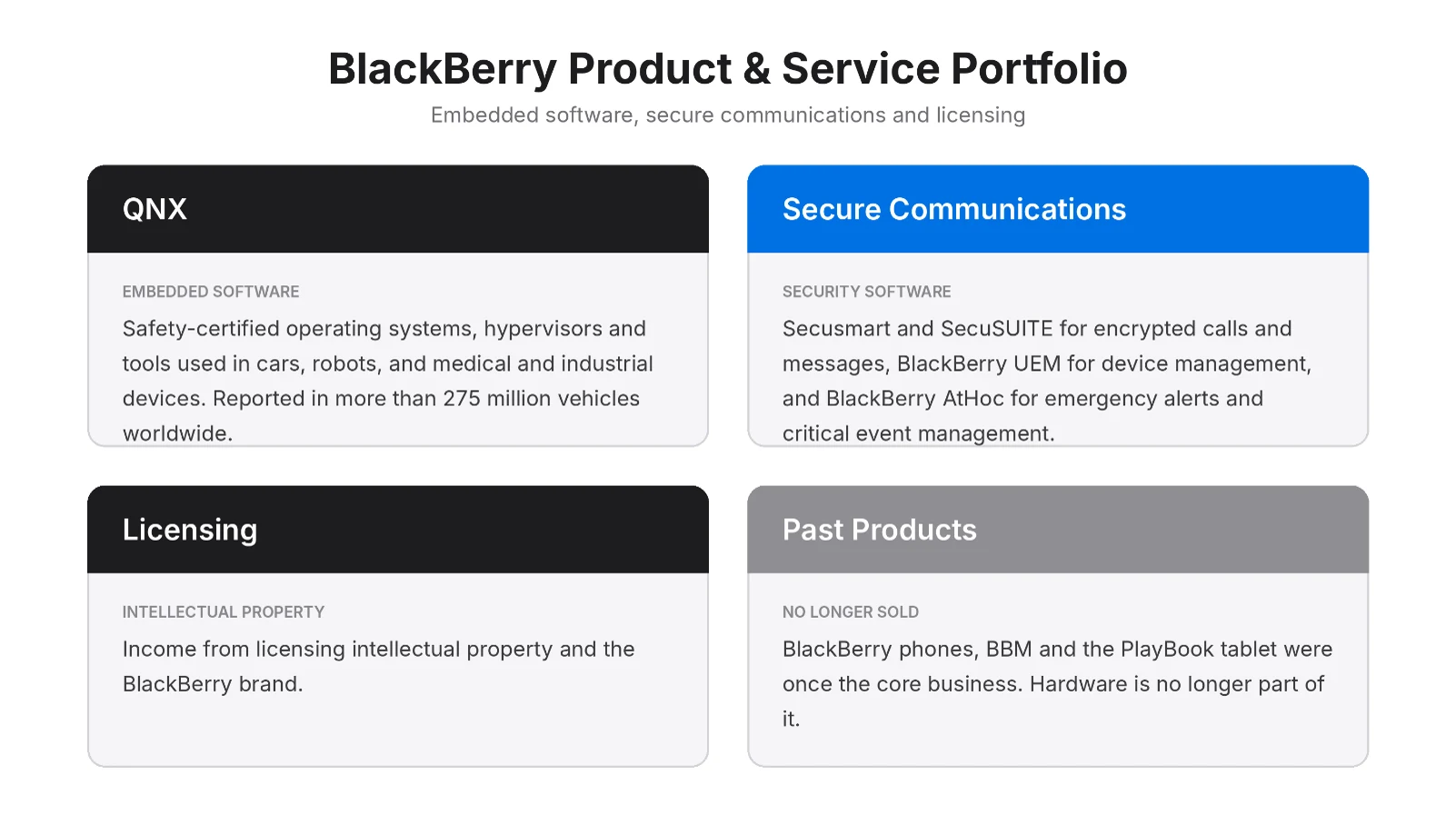
BlackBerry's business model is now based on software rather than devices. Its main components are:
Royalties and licences: QNX earns revenue when automakers and device makers ship products that include its software. The company reports a royalty backlog of about $950 million.
Subscriptions and support: Secure Communications earns recurring revenue from software licences, subscriptions and support.
Trust and certification: Customers such as automakers and governments choose BlackBerry for its security and safety credentials.
Partner channels: BlackBerry reaches customers through automakers, chip makers, suppliers and software partners, not through consumer retail.
Revenue and Business Performance
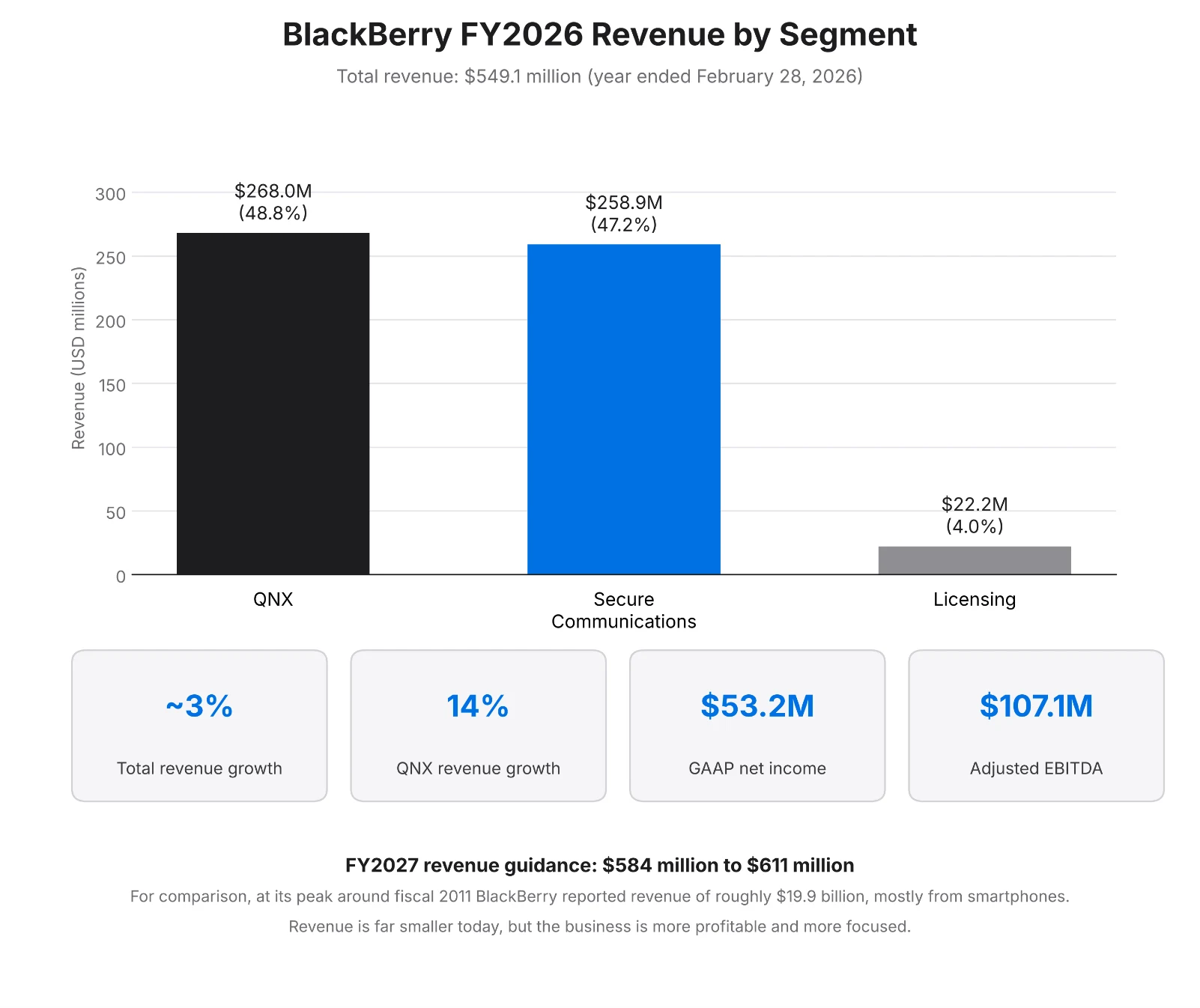
The figures below are drawn from BlackBerry's reported results for fiscal 2026 (year ended February 28, 2026). They show the contribution of each segment to the company's business.
Marketing Strategy
Business-first positioning : In its peak years BlackBerry marketed to professionals, governments and enterprises, stressing security, productivity and reliable email.
Strong product identity : The physical keyboard and BlackBerry Messenger created a recognizable identity and loyal users.
Enterprise and government sales : The company relied on long-term relationships with IT departments and public-sector buyers rather than mass-market advertising.
Trust and certification : Today its marketing emphasizes security credentials, safety certifications and customer references from automakers and governments.
Developer outreach : Programs such as QNX Everywhere offer free licences and academic partnerships to encourage adoption among developers and students.
Technology and Innovation
QNX operating system : A real-time microkernel design with safety certifications supports systems where failure is not acceptable, such as braking and driver assistance.
Software-defined vehicles : QNX is positioned as a foundation for software-defined vehicles, with announced work involving automakers such as BMW and Volvo.
Secure communications : Encryption and secure-device technology serve government and regulated users, a market supported by growing interest in digital sovereignty.
Robotics and physical AI : QNX is extending into robotics and other autonomous systems that need safety-certified software.
Major Challenges
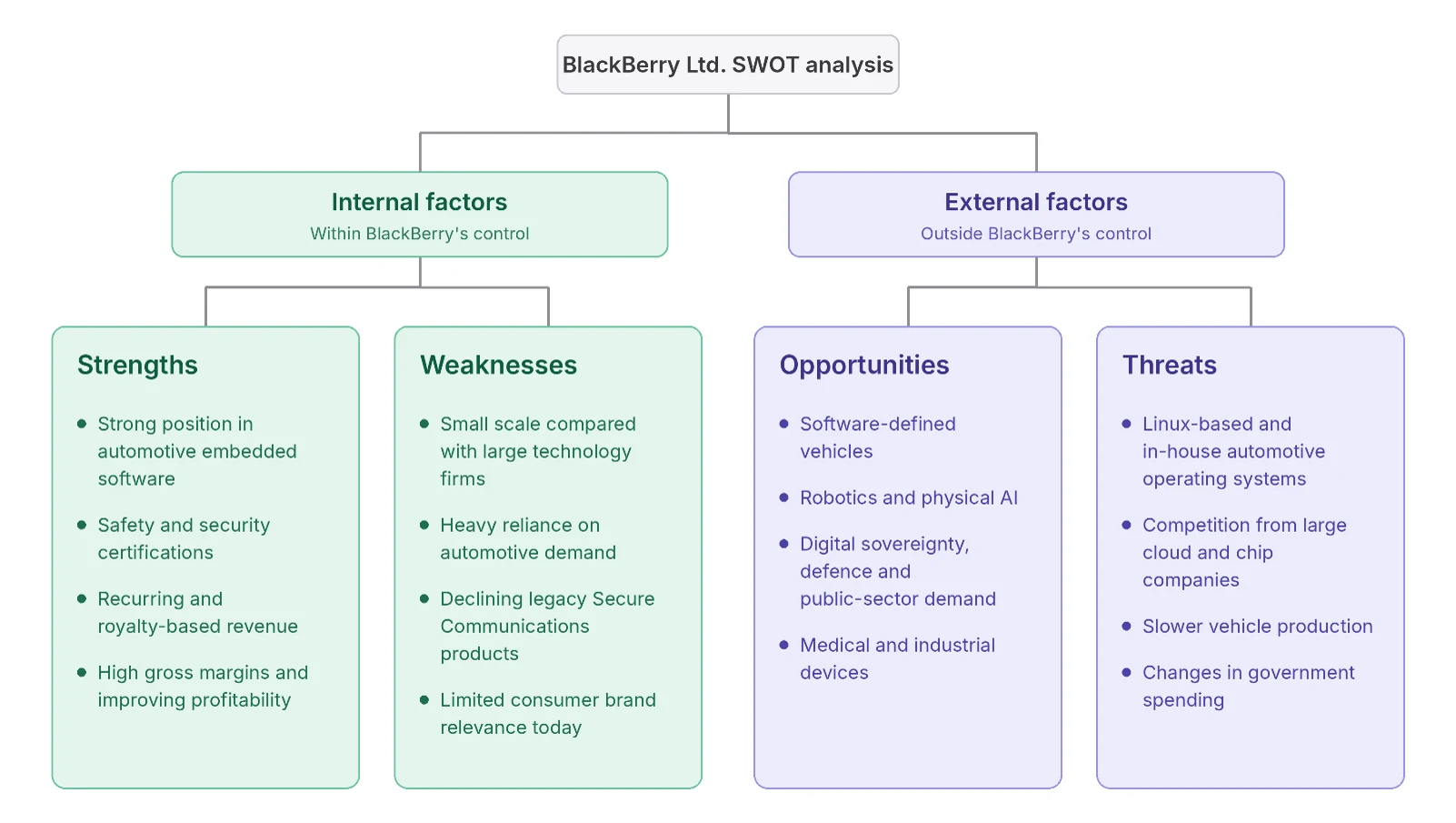
Loss of the smartphone market : BlackBerry was slow to respond to touchscreens and app-centred smartphones. Developers favoured iOS and Android, which created a cycle of fewer apps and fewer customers.
Weak ecosystem : BlackBerry had strong enterprise software but lacked the large developer and consumer app ecosystem that drove its competitors.
Late platform transition : BlackBerry 10 arrived late and could not recover the lost momentum, even though the software was well regarded.
Competition in embedded software : Automakers have several options, including open-source systems and in-house platforms, so QNX must keep proving its value.
Scale and concentration : The company depends on a limited number of large customers and is far smaller than the technology companies it competes with.
Strategies for Future Growth
• Grow QNX in automotive and expand into robotics, medical and industrial markets.
• Convert the royalty backlog into steady revenue as vehicle programs launch.
• Rebuild growth in Secure Communications through government, defence and digital sovereignty demand.
• Invest in safety and security certifications that competitors find hard to match.
• Maintain cost discipline and cash generation while investing selectively in products.
Key Business Lessons
Leadership is not permanent: A strong position can disappear quickly if a company does not respond to changing customer behaviour.
Ecosystems matter as much as products: Developers, apps and services decide the success of a platform, not hardware features alone.
Take new competitors seriously: Early dismissal of the iPhone as a limited threat proved costly.
Know your core strengths: BlackBerry recovered by returning to security, reliability and embedded software.
Reinvention requires hard choices: Exiting hardware, selling businesses and patents, and simplifying the portfolio were difficult but necessary.
Recurring revenue builds resilience: Royalties, subscriptions and long-term contracts offer more predictable income than device sales.
Conclusion
BlackBerry's journey from the leading business smartphone maker to a focused software company shows both the danger of disruption and the possibility of renewal. Its decline came from slow adaptation to touchscreens, apps and changing expectations. Its recovery has been built on its technical credibility in security and safety-critical software.
The company still faces competition, limited scale and dependence on the automotive industry. Its ability to keep growing QNX and rebuild Secure Communications will shape its future. BlackBerry's experience offers useful lessons in innovation, strategic focus and adaptability.
Frequently asked questions
What is BlackBerry Ltd. known for?
What are BlackBerry's major products today?
Why did BlackBerry lose the smartphone market
Does BlackBerry still make phones?
No. BlackBerry stopped designing its own phones in 2016, and the licensed phones that followed have also ended.
What are the key lessons from BlackBerry's story?

Arun G
Full stack developer
A passionate technology enthusiast with an interest in web development, innovation, and emerging technologies. Enjoys creating user-friendly digital experiences, exploring new tools, and turning creative ideas into practical solutions.