
Tata Group: Building a Global Business Through Trust and Innovation
Exploring Tata Group's journey of growth, innovation, diversification and leadership with trust.
6 min read · 39 views · By Arun G
- Client / anonymised name
- Tata Group
- Industry
- Diversified Industries
- Service type
- Business Analysis & Strategic Research
- Project type
- Corporate Business Case Study
- Region
- India / Global
In this case study
Executive Summary
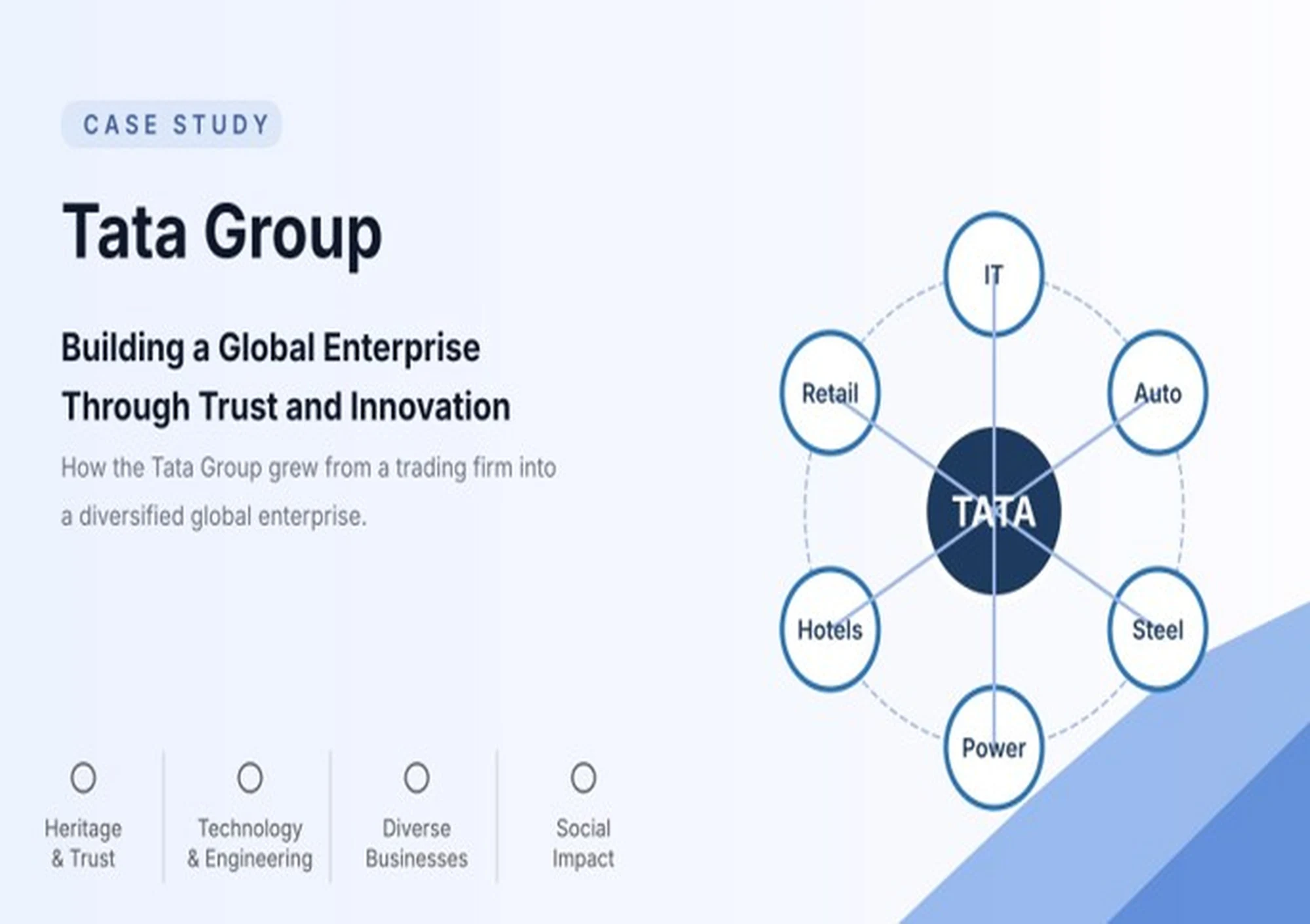
The Tata Group is one of India's oldest and most respected business groups, recognized for its work across technology, automotive, steel, energy, consumer products, hospitality and aviation. Founded in 1868 by Jamsetji Tata, it developed from a small trading firm into a global enterprise present in more than 100 countries. Its strategy combines diverse businesses, long-term thinking and a strong commitment to trust and ethics.
Introduction
Large business groups must balance growth with responsibility. They need to invest in new technologies, manage many industries at once and keep the trust of customers, employees and society.
The Tata Group is a prominent example of a company that has tried to grow while keeping a clear set of values. Its well-known principle of 'Leadership with Trust', together with a long tradition of philanthropy, contributes to a consistent and widely recognised brand identity.
Company Background
The Tata Group was founded in 1868 by Jamsetji Tata, who began with a trading company in Mumbai. He is also remembered for his vision of an Indian steel industry, a hydroelectric power supply and a world-class institute of science, ideas that were later realised by the group and its successors.
Over the following decades, the group entered hotels, steel, power, aviation, vehicles and information technology. Tata Sons is the principal investment holding company and owns the Tata brand, while each Tata company operates independently under its own board. Tata Trusts hold about two-thirds of Tata Sons, which means a large part of the group's profits supports education, healthcare and community development.
Major Milestones
YEAR |
Major development |
|---|---|
| 1868 | Jamsetji Tata founds a trading company in Mumbai. |
| 1903 |
The Taj Mahal Palace hotel opens in Mumbai. |
| 1907 |
Tata Steel is established at Jamshedpur. |
| 1932 | Tata Airlines is founded; it later becomes Air India. |
| 1945 | Tata Motors (then TELCO) is established. |
| 1968 | Tata Consultancy Services (TCS) is established. |
| 1991 |
Ratan Tata becomes chairman of Tata Sons. |
| 2008 | Tata Motors acquires Jaguar Land Rover. |
| 2016 | N Chandrasekaran becomes chairman of Tata Sons. |
| 2022 | Air India returns to the Tata Group. |
| 2025 | Tata Motors separates into passenger and commercial vehicle companies. |
Products and Services
Business Model
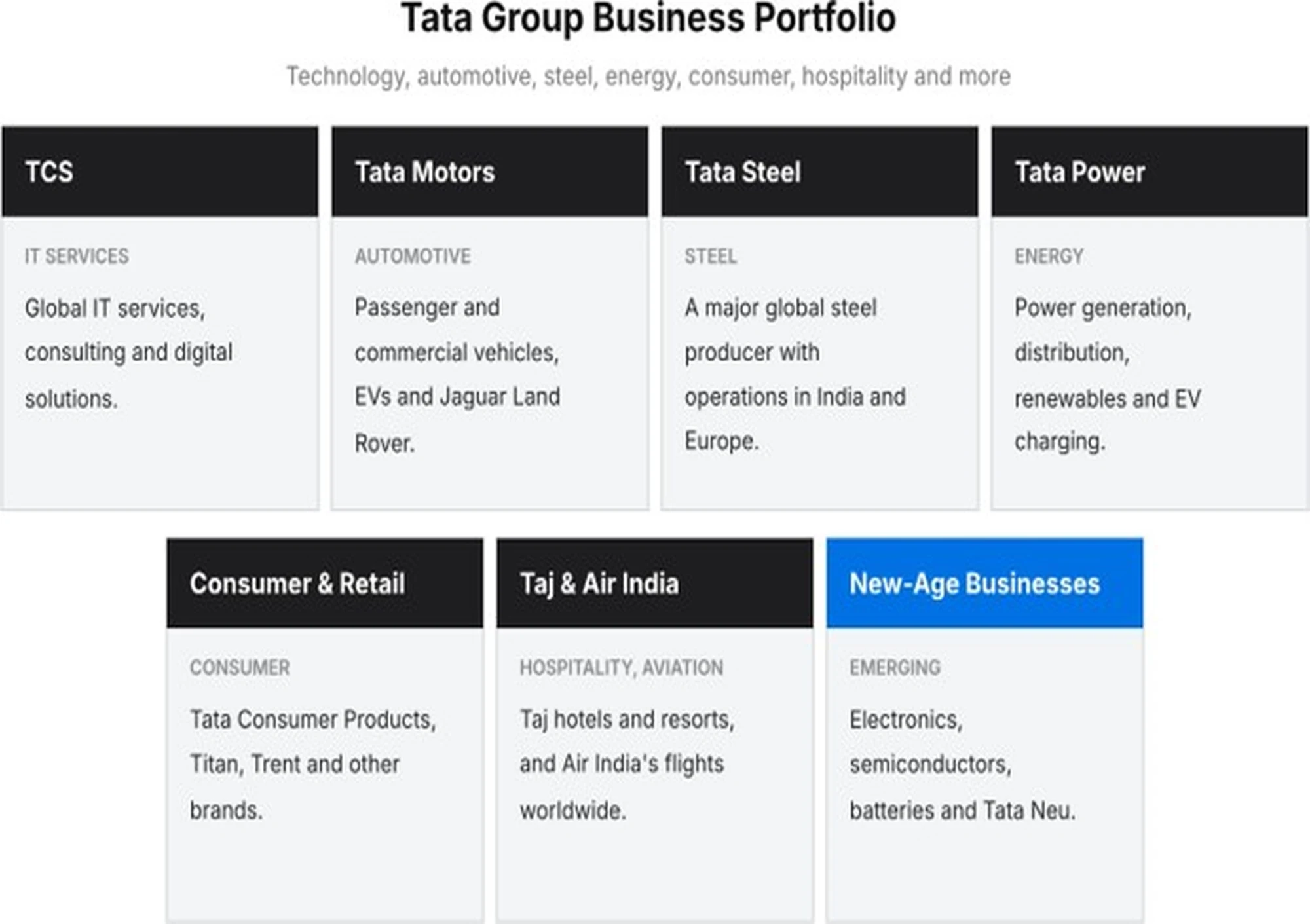
The Tata Group operates as a federation of independent companies under a common brand and shared values. Its main components are:
• Holding structure: Tata Sons is the principal investment holding company and promoter of Tata companies, with Tata Trusts as its largest shareholder.
• Independent companies: Each Tata company has its own board and management, and focuses on its own industry.
• Brand and values: Group companies use the Tata name under a brand-equity agreement and follow a shared code of conduct.
• Diversified income: Revenue comes from technology services, vehicles, steel, power, consumer goods, hotels, aviation and electronics, which spreads risk across sectors.
Revenue and Business Performance
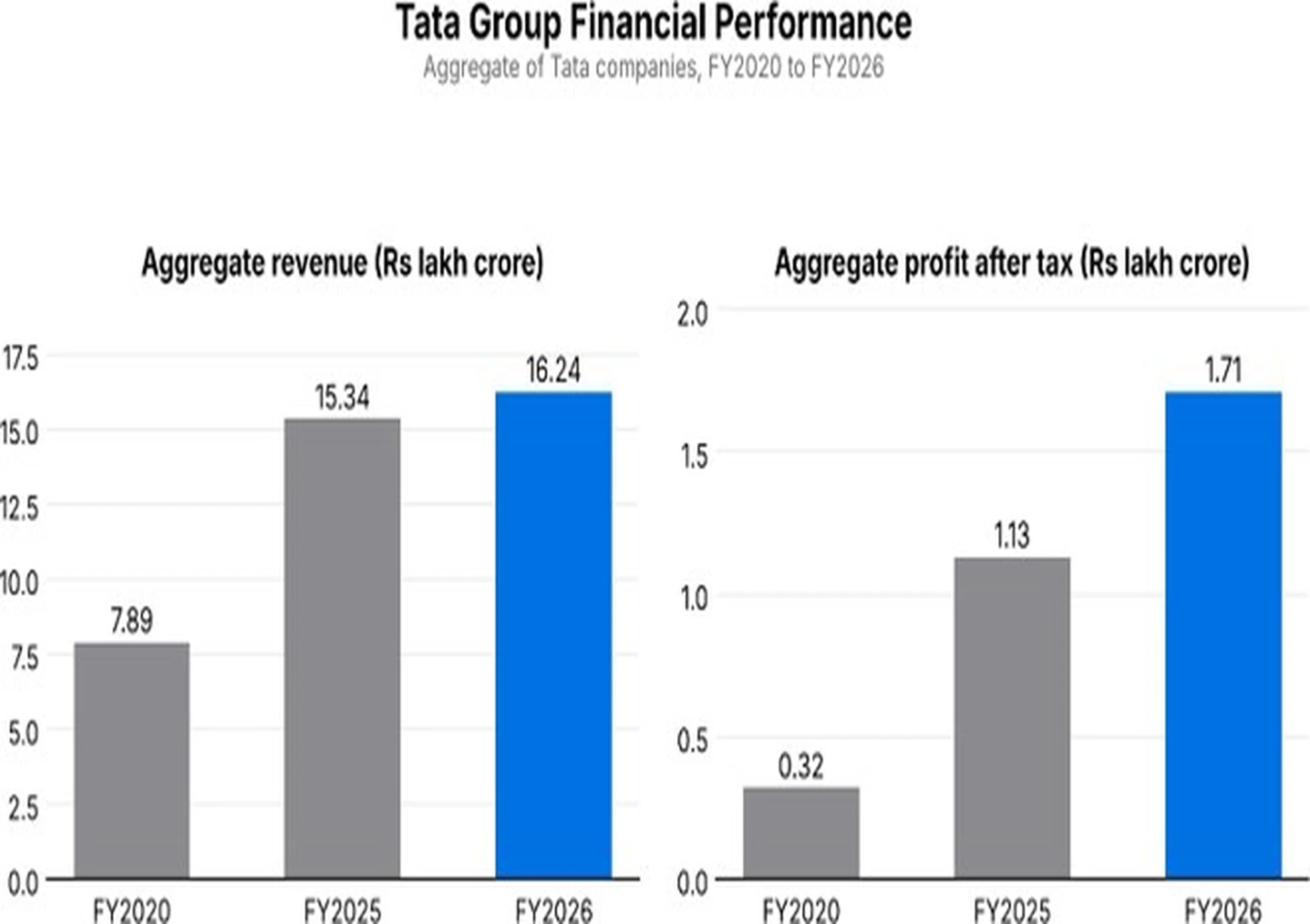
The figures below are taken from the Tata Sons Annual Report 2025-26. Aggregate revenue of Tata companies was about Rs 16.24 lakh crore (roughly US$185 billion) in FY2026, compared with Rs 7.89 lakh crore in FY2020. Aggregate profit after tax was about Rs 1.71 lakh crore, which includes some one-time gains linked to the Tata Motors separation. The group's 26 listed companies had a combined market capitalisation of about Rs 24.39 lakh crore at 31 March 2026.
Marketing Strategy
Trust-led branding : The Tata name is associated with reliability, ethics
and service to society, which
supports every product
category.
Strong
individual brands : Brands such as Taj, Tanishq, Tata Nexon, Tata Tea and
TCS reach customers in their own markets while sharing the group's reputation.
Sponsorship
and visibility : Association with major sporting
events, including the Indian Premier
League, raises awareness among large audiences.
Social impact : Education, healthcare and
community programmes funded by
Tata Trusts strengthen goodwill
and long-term
loyalty.
Connected experience : Digital platforms
such as Tata Neu aim to link shopping, travel and services
across group brands.
Technology and Innovation
Digital
and AI services : TCS provides
software, cloud and AI-based services
to customers around
the world.
Electric mobility : Tata Motors has built a leading position
in electric passenger vehicles in India,
supported by Tata Power's charging network.
Electronics
and semiconductors : Tata Electronics is building capabilities
in
electronics manufacturing and semiconductors,
an
area of long-term
investment.
Clean energy and green steel : Tata Power
is growing renewable energy, and Tata Steel is working to reduce carbon
emissions from steelmaking.
Major Challenges
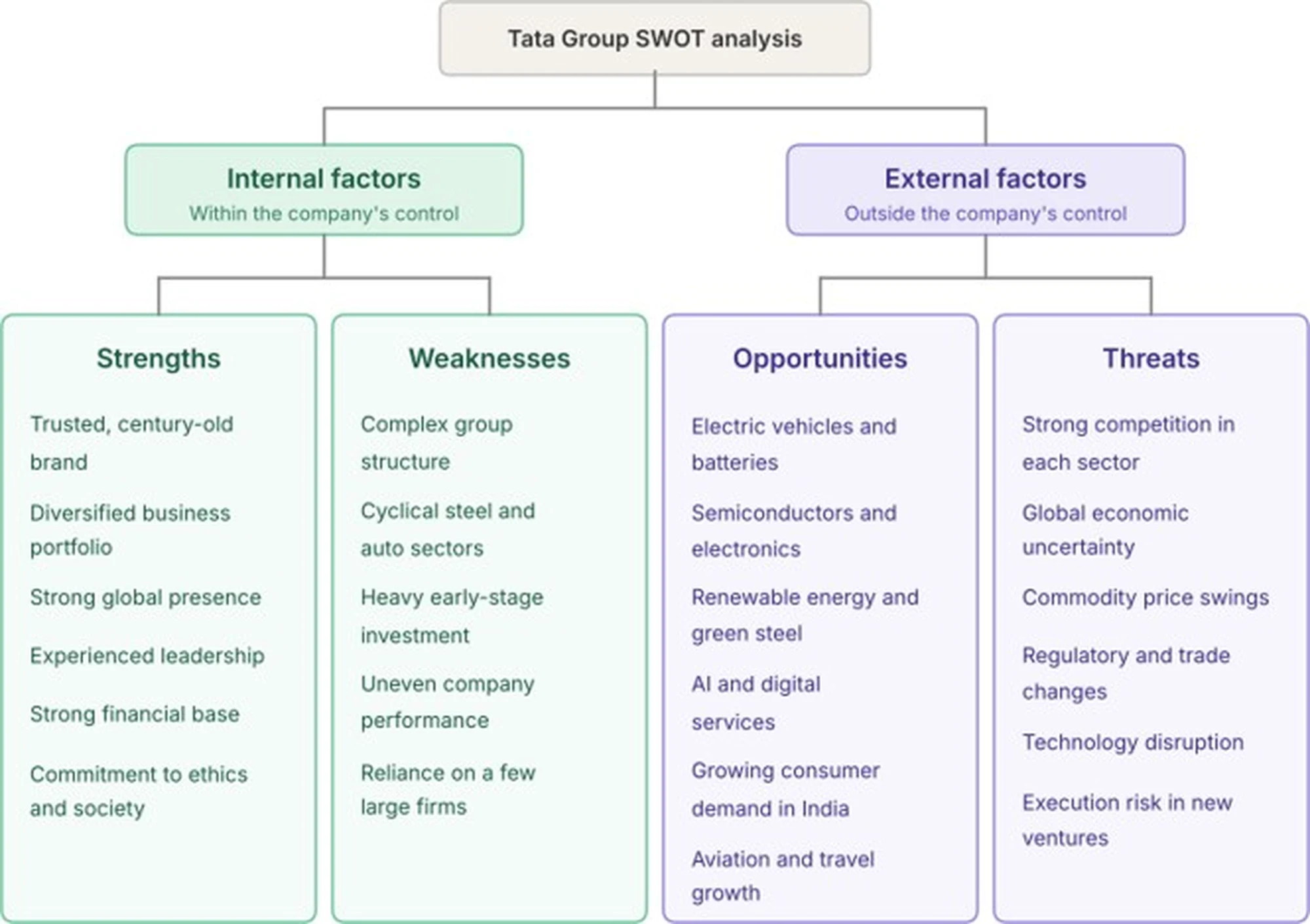
- Managing a
diverse portfolio : Operating in many industries requires careful capital
allocation and strong
management in each company.
- Cyclical industries : Steel and automotive businesses can be affected
by commodity prices,
demand cycles and trade conditions.
- Investment in new ventures : Areas such as electronics, semiconductors and batteries
need heavy investment before they reach stable profits.
- Competition and regulation : Each business faces strong competitors and changing rules in India and in international markets.
Strategies for Future Growth
- Invest in new-age businesses such as electric vehicles, batteries, semiconductors and electronics manufacturing.
- Expand renewable energy and move towards greener steel production.
- Strengthen digital and AI capabilities across technology services and consumer platforms.
- Improve aviation by integrating and modernising Air India's network and fleet.
- Continue supporting education, healthcare and community development through Tata Trusts.
Key Business Lessons
1. Trust builds lasting brands: Ethical conduct over many decades creates deep customer and public confidence.
2. Long-term thinking pays off: Patient investment in industries such as steel, power and technology built enduring businesses.
3. Independent companies, shared values: Letting each company run on its own while sharing a common identity supports focus and accountability.
4. Diversification spreads risk: Operating in many sectors reduces dependence on any single market.
5. Purpose and profit can coexist: Giving back to society has been part of the group's identity from the beginning.
6. Renewal is essential: Entering new fields such as electronics and electric mobility shows the need to evolve.
Conclusion
The Tata Group's journey from a small trading firm to a global enterprise demonstrates the importance of trust, long-term vision, ethical conduct and adaptability. Its position is supported by a respected brand, a diversified portfolio, strong financial performance and a deep commitment to society.
The group continues to face challenges such as competition, cyclical industries, heavy investment in new ventures and a changing regulatory environment. Its ability to modernise while staying true to its values will remain central to future growth.
Frequently asked questions
What is the Tata Group known for?
The Tata Group is known for its trusted brand, diverse businesses and long tradition of ethical conduct and philanthropy.
What are its major businesses?
Its major businesses include TCS, Tata Motors, Tata Steel, Tata Power, Tata Consumer Products, Titan, Trent, Taj hotels, Air India and Tata Electronics.
Who owns the Tata Group?
Tata Sons is the principal holding company, and Tata Trusts hold about two-thirds of its shares.
What are the key lessons from its success?
Trust, long-term thinking, diversification, social purpose and adaptability are key lessons from its journey.

Arun G
Full stack developer
A passionate technology enthusiast with an interest in web development, innovation, and emerging technologies. Enjoys creating user-friendly digital experiences, exploring new tools, and turning creative ideas into practical solutions.