
Royal Enfield: Building a Heritage Brand for the Digital Age
How a century-old motorcycle brand connects with a new generation of riders
6 min read · 63 views · By Shalini B
- Client / anonymised name
- Royal Enfield
- Industry
- Automotive (Premium Motorcycles)
- Service type
- Brand Strategy and Digital Marketing
- Project type
- Brand and Customer Experience Study
- Project duration
- 6 months
- Region
- India and Global Markets
In this case study
Executive Summary
Royal Enfield is one of the world's oldest motorcycle brands still in production, recognized for its classic styling, simple
engineering and relaxed riding experience. Founded in 1901 in England and manufactured in India since 1955, it is now
part of Eicher Motors and a leading name in the global middleweight (250cc to 750cc) segment. Its strategy combines
heritage, modern engineering and a strong rider community.
Introduction
Motorcycling has changed from basic transportation into a space for leisure, identity and adventure. Companies must
continually improve products, adopt relevant technologies and deliver dependable experiences to remain competitive.
Royal Enfield is a prominent example of a company that competes not only through technical specifications but also
through character, comfort and the experience of the journey. Its design language, touring culture and community events
contribute to a consistent brand identity.
Company Background
Royal Enfield traces its roots to the Enfield Cycle Company of Redditch, England, which built its first motorcycle in 1901.
The name reflects early links with the Royal Small Arms Factory at Enfield, and the well-known slogan 'Made like a gun'
grew from that heritage.
In 1955, Enfield India began assembling the Bullet in Chennai, and local manufacturing followed. The UK business closed
in 1970, while the Indian operation continued. In 1994, Eicher Motors acquired the company, beginning a period of
modernisation and expansion. Royal Enfield now earns revenue from motorcycles, spare parts, riding apparel and
accessories.
Major Milestones
Year | Major development |
|---|---|
| 1901 | Enfield Cycle Company builds its first motorcycle. |
| 1955 | Bullet assembly begins in Chennai, India. |
| 1994 | Eicher Motors acquires Royal Enfield. |
| 2009 | Classic 350 launched with a fuel-injected engine. |
| 2016 | Himalayan introduced, entering adventure touring. |
| 2018 | Interceptor 650 and Continental GT 650 launched. |
| 2020 | Meteor 350 launched on the new J-series platform. |
| 2022 | Hunter 350 expands the entry-level range. |
| 2023 | Himalayan 450 and Super Meteor 650 introduced. |
| 2026 | 125th anniversary; Flying Flea electric brand launched. |
These milestones illustrate Royal Enfield's growth from a historic marque into a diversified, globally active motorcycle company.
Products and Services
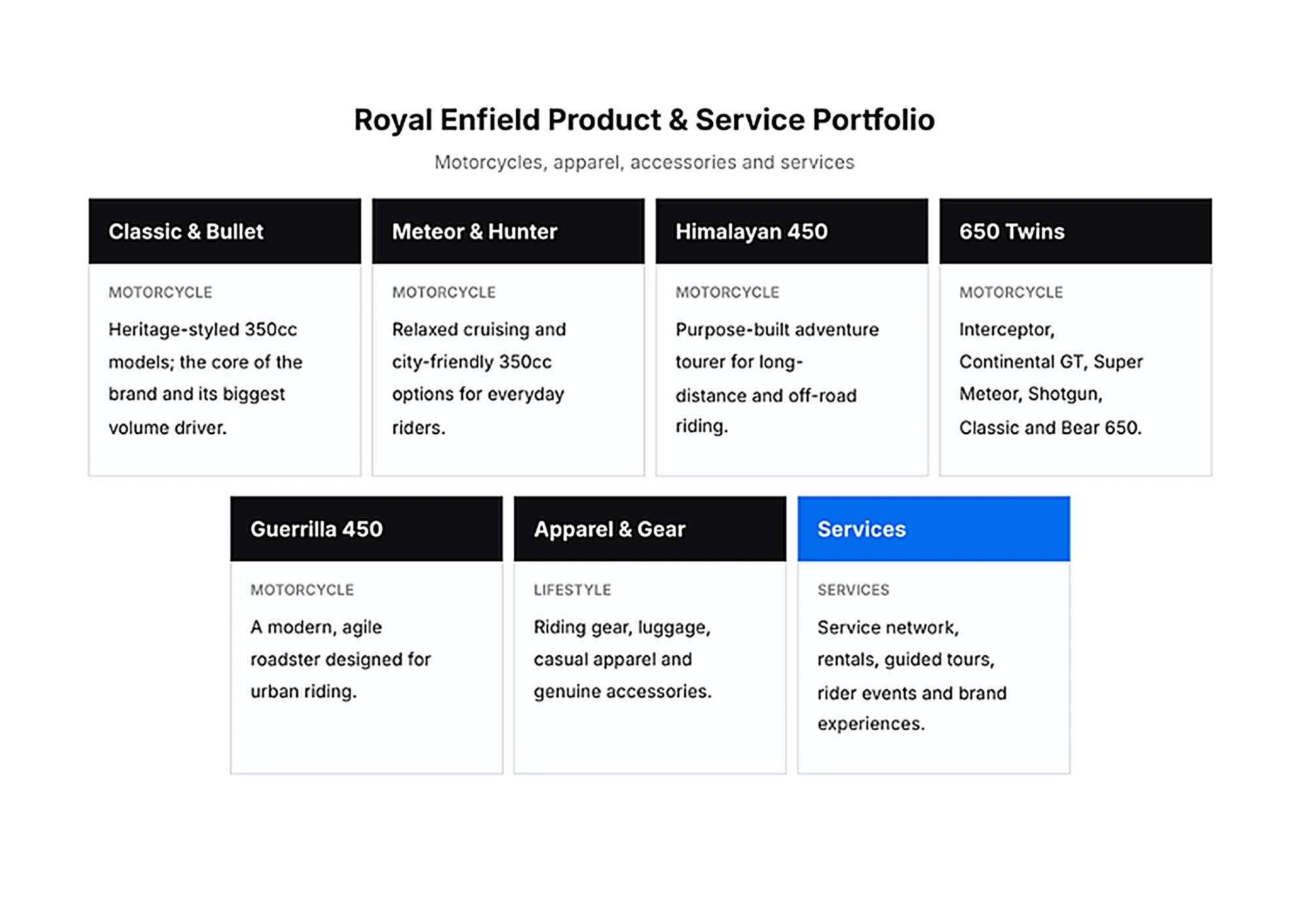
Business Model
Royal Enfield's business model combines focused motorcycle manufacturing, a strong brand and a growing ecosystem of
accessories and experiences. Its main components are:
- Motorcycle sales: Revenue from the 350cc, 450cc and 650cc ranges, positioned primarily in the mid-premium market.
- Allied revenue: Income from spare parts, accessories, riding gear and apparel.
- Brand ecosystem: Rides, tours and events such as the Himalayan Odyssey and Motoverse build a loyal community around the products.
- Direct and indirect sales: Royal Enfield reaches customers through dealerships, Studio Stores, service centres, distributors and international assembly partners.
Revenue and Business Performance
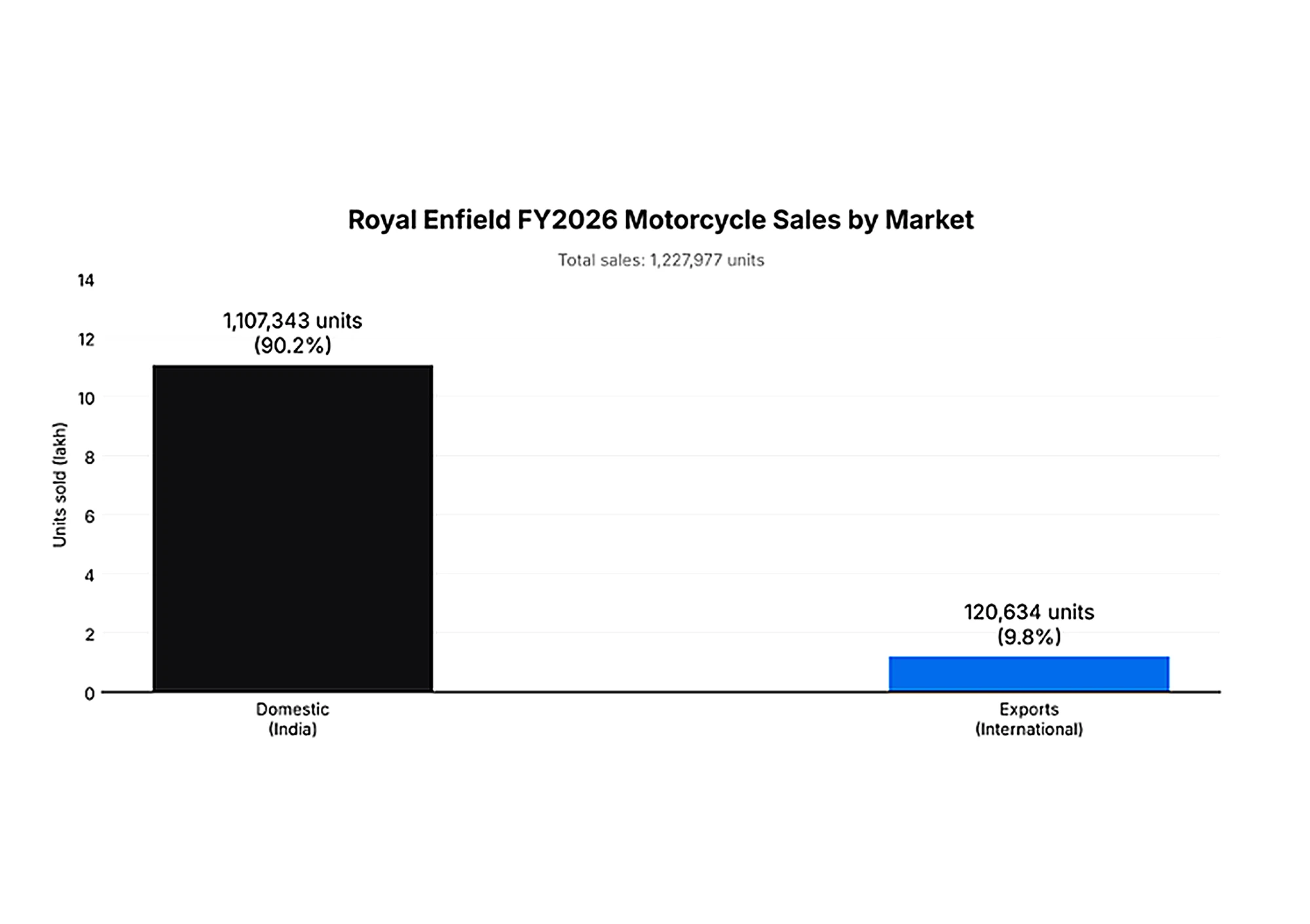
The figures below are taken from Eicher Motors' FY2026 results (year ended 31 March 2026). Royal Enfield sold 1,227,977
motorcycles, its highest-ever annual volume and the second consecutive year above one million. Eicher Motors'
consolidated revenue from operations was about n23,408 crore, with profit after tax of about n5,515 crore.
Marketing Strategy
Heritage-led branding : Royal Enfield emphasises its long history, authentic design and the idea of pure motorcycling, rather than competing on
specifications alone.
Community and rides :
Owner groups, long-distance rides, festivals and guided tours turn customers into brand ambassadors.
Storytelling :
Films, travel stories and social media celebrate journeys, which suits a product built for exploration.
Personalisation : Special editions, colour options and a wide accessories range let riders make the motorcycle their own.
Retail experience : Studio Stores and dealerships allow customers to take test rides, explore apparel and receive service support.
Technology and Innovation
Engine platforms :
Modern 350cc, 450cc and 650cc engines improve refinement and reliability while keeping the familiar Royal Enfield
character.
Global engineering :
Technology centres in Chennai and the United Kingdom support design and development to international standards.
Rider technology :
Newer models add features such as ABS, riding modes, LED lighting and Tripper navigation.
Electric mobility :
The Flying Flea brand marks Royal Enfield's entry into electric motorcycles, with the C6 launched in April 2026.
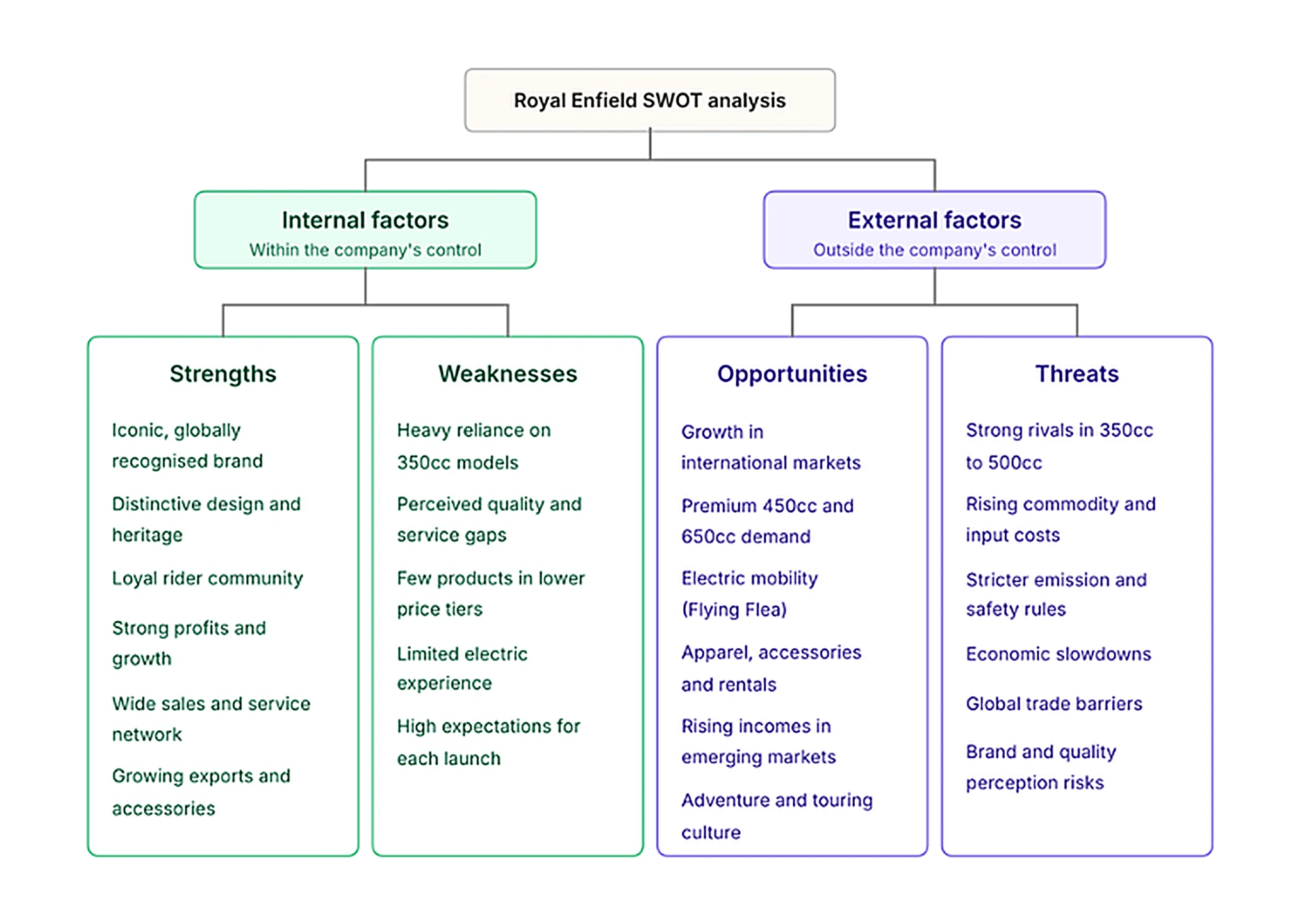
Royal enfield SWOT analysis
Major Challenges
Intense market competition :
Royal Enfield competes with companies such as Honda, TVS, Jawa, Yezdi, Bajaj-Triumph and Harley-Davidson. New
models are regularly introduced in the 350cc to 500cc space.
Quality and service perception :
Earlier quality concerns have influenced some customers' views, so consistent build quality and service remain important.
Dependence on core models : A large share of volume comes from the 350cc range, so changes in demand or competition there have a significant effect.
Regulation and technology change :
Stricter emission and safety rules and the shift to electric mobility require continued investment in research and
development.
Strategies for Future Growth
• Expand production capacity, including planned expansion at Cheyyar in Tamil Nadu and a new facility in Andhra
Pradesh.
• Strengthen presence in international markets through assembly partners, new dealers and suitable products.
• Grow the premium range with 450cc and 650cc motorcycles.
• Develop electric mobility through the Flying Flea brand.
• Expand apparel, accessories, rentals and community experiences.
Key Business Lessons
1. Heritage creates value: Authentic history, when respected, builds trust and emotional connection.
2. Experience matters: Rides and communities create lasting customer relationships.
3. Modernise without losing identity: Better engineering can coexist with classic character.
4. Focus builds leadership: Concentrating on the middleweight segment has strengthened the brand.
5. Quality earns trust: Consistent build quality and service support long-term reputation.
6. Adaptability is essential: New segments and electric mobility show the need to evolve.
Conclusion
Royal Enfield's journey from a small English workshop to a global motorcycle brand demonstrates the importance of
heritage, focus, product quality and customer experience. Its position is supported by iconic design, a loyal community,
growing capacity and an expanding international presence.
The company continues to face challenges such as competition, quality expectations, regulatory change and the shift to
electric mobility. Its ability to modernise while staying true to its character will remain important to future growth.
Frequently asked questions
What is Royal Enfield known for?
Royal Enfield is known for classic-styled, easy-to-ride motorcycles and a strong touring and community culture.
What are its major products?
Its major products include the Classic, Bullet, Meteor, Hunter, Himalayan, Guerrilla and 650cc range, along with apparel
and accessories.
Who owns Royal Enfield?
It is part of Eicher Motors Limited, which acquired the company in 1994.
What are its major competitors?
Royal Enfield competes with companies such as Honda, TVS, Jawa, Yezdi, Bajaj-Triumph and Harley-Davidson.
What are the key lessons from its success?
Heritage, focus, community, product quality and adaptability are important lessons from its journey.
About the author
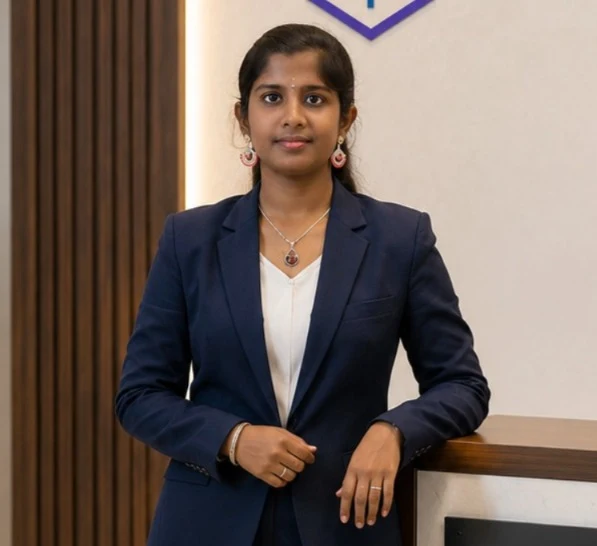
Shalini B
Founder & CEO
Shalini B, Founder & CEO of Inovate Solution Technology, is a technology professional specializing in Cloud Computing, DevOps, and Software Development.Passionate about innovation and digital transformation, she shares industry insights to empower students, developers, and businesses.